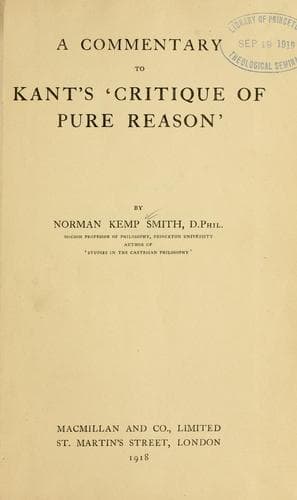
A Commentary to Kant's 'Critique of Pure Reason'Smith, Norman Kemp
Philosophy
A Commentary to Kant's 'Critique of Pure Reason'
Smith, Norman Kemp
Kant, Immanuel, 1724-1804. Kritik der reinen Vernunft
The grounds for the former assertion are not here considered, and that
is doubtless the reason why the _oder nicht_ is excised in Kant’s
private copy of the _Critique_. As we have seen, Kant does not anywhere
in the _Aesthetic_ even attempt to offer argument in support of this
assertion. In defence of (_a_) Kant propounds for the first time the
view of sensibility as a limitation. Space is a limiting condition to
which human intuition is subject. Whether the intuitions of other
thinking beings are subject to the same limitation, we have no means of
deciding. But for all human beings, Kant implies, the same conditions
must hold universally.[477]
In the phrase “transcendental ideality of space”[478] Kant, it may be
noted, takes the term ideality as signifying subjectivity, and the term
transcendental as equivalent to transcendent. He is stating that judged
from a _transcendent_ point of view, _i.e._ from the point of view of
the thing in itself, space has a merely subjective or “empirical”
reality. This is an instance of Kant’s careless use of the term
transcendental. Space is empirically real, but taken _transcendently_,
is merely ideal.[479]
KANT’S ATTITUDE TO THE PROBLEMS OF MODERN GEOMETRY
This is an appropriate point at which to consider the consistency of
Kant’s teaching with modern developments in geometry. Kant’s attitude
has very frequently been misrepresented. As he here states, he is
willing to recognise that the forms of intuition possessed by other
races of finite beings may not coincide with those of the human species.
But in so doing he does not mean to assert the possibility of other
_spatial_ forms, _i.e._ of spaces that are non-Euclidean. In his
pre-Critical period Kant had indeed attempted to deduce the
three-dimensional character of space as a consequence of the law of
gravitation; and recognising that that law is in itself arbitrary, he
concluded that God might, by establishing different relations of
gravitation, have given rise to spaces of different properties and
dimensions.
“A science of all these possible kinds of space would undoubtedly
be the highest enterprise which a finite understanding could
undertake in the field of geometry.”[480]
Public-domain text, read in full here on John Shaqi.
Reviews
Reviews
No reviews yet
Be the first to share your thoughts on this work.
Elsewhere in the archive
Join the Discussion
Join the discussion
Sign in to leave a comment or review.
Sign InorCreate an account