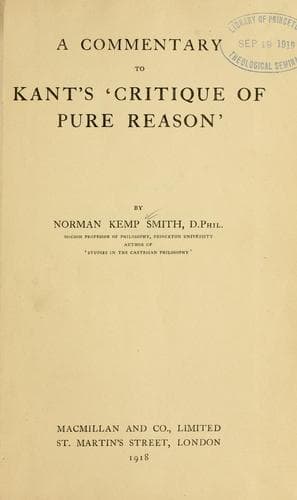
A Commentary to Kant's 'Critique of Pure Reason'Smith, Norman Kemp
Philosophy
A Commentary to Kant's 'Critique of Pure Reason'
Smith, Norman Kemp
Kant, Immanuel, 1724-1804. Kritik der reinen Vernunft
”[Even discounting Kant’s insistence upon the conceptual character
of arithmetical science, and] allowing that he derives arithmetical
concepts and propositions from the _pure intuition of time_, this
teaching, to whatever objections it may lie open, has certainly not
the merely _psychological_ meaning which the majority of its
critics have ascribed to it. If it contained only the trivial
thought, that the empirical act of counting requires time, it would
be completely refuted by the familiar objection which B. Beneke has
formulated: ‘The fact that time elapses in the process of counting
can prove nothing; for what is there over which time does not
flow?’ It is easily seen that Kant is only concerned with the
‘transcendental’ determination of the concept of time, according to
which it appears as the type of an ordered sequence. William
[Rowan] Hamilton, who adopts Kant’s doctrine, has defined algebra
as ‘science of pure time or _order in progression_.’ That the whole
content of arithmetical concepts can really be obtained from the
fundamental concept of _order_ in unbroken development, is
completely confirmed by Russell’s exposition. As against the
Kantian theory it must, of course, be emphasised, that it is not
the _concrete_ form of time intuition which constitutes the
_ground_ of the concept of number, but that on the contrary the
pure logical concepts of sequence and of order are already
implicitly contained and embodied in that concrete form.”
Public-domain text, read in full here on John Shaqi.
Reviews
Reviews
No reviews yet
Be the first to share your thoughts on this work.
Elsewhere in the archive
Join the Discussion
Join the discussion
Sign in to leave a comment or review.
Sign InorCreate an account