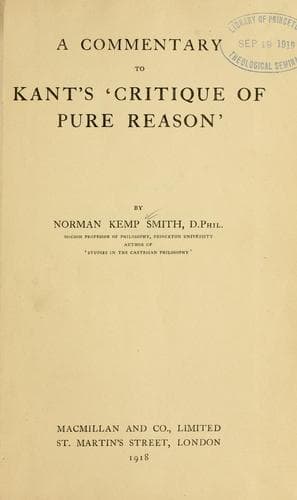
A Commentary to Kant's 'Critique of Pure Reason'Smith, Norman Kemp
Philosophy
A Commentary to Kant's 'Critique of Pure Reason'
Smith, Norman Kemp
Kant, Immanuel, 1724-1804. Kritik der reinen Vernunft
=Second Paragraph.=--This paragraph states (_a_) that through intuition we
can represent only appearances, not things in themselves, and (_b_) that
the appearances thus known exist only in us. Both assertions have
implications, the discussion of which must be deferred to the
_Analytic_. The mention of the “relations of things by themselves” may,
as Vaihinger suggests,[565] be a survival from the time when (as in the
_Dissertation_[566]) Kant sought to reduce spatial to dynamical
relations. The assertion that things in themselves are completely
unknown to us goes beyond what the _Aesthetic_ can establish and what
Kant here requires to prove. His present thesis is only that no
knowledge of things in themselves can be acquired either through the
forms of space and time or through sensation; space and time are
determined solely by our pure sensibility, and sensations by our
empirical sensibility. Failure to recognise this is, in Kant’s view, one
of the chief defects of the Leibnizian system.
=Third and Fourth Paragraphs. Criticism of the Leibniz-Wolff
Interpretation of Sensibility and of Appearance.=--Leibniz vitiates both
conceptions. Sensibility does not differ from thought in clearness but
in content. It is a difference of kind.[567] They originate in different
sources, and neither can by any transformation be reduced to the other.
“Even if an appearance could become completely transparent to us,
such knowledge would remain _toto coelo_ different from knowledge
of the object in itself.”[568] “Through observation and analysis of
appearances we penetrate to the secrets of nature, and no one can
say how far this may in time extend.... [But however far we
advance, we shall never be able by means of] so ill-adapted an
instrument of investigation [as our sensibility] to find anything
except still other appearances, the non-sensuous cause of which we
yet long to discover.”[569]
We should still know only in terms of the two inalienable forms of our
sensibility.[570] The dualism of thought and sense can never be
transcended by the human mind. By no extension of its sphere or
perfecting of its insight can sensuous knowledge be transformed into a
conceptual apprehension of purely intelligible entities.
Public-domain text, read in full here on John Shaqi.
Reviews
Reviews
No reviews yet
Be the first to share your thoughts on this work.
Elsewhere in the archive
Join the Discussion
Join the discussion
Sign in to leave a comment or review.
Sign InorCreate an account