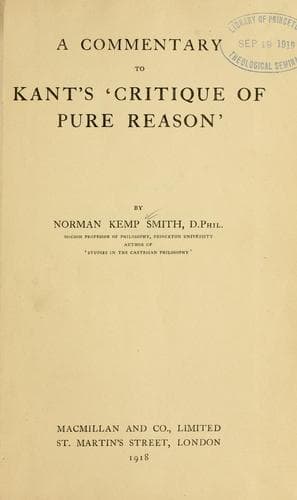
A Commentary to Kant's 'Critique of Pure Reason'Smith, Norman Kemp
Philosophy
A Commentary to Kant's 'Critique of Pure Reason'
Smith, Norman Kemp
Kant, Immanuel, 1724-1804. Kritik der reinen Vernunft
But this view of illusion is peculiar to the passage before us and to A
38 = B 55. It occurs nowhere else, either in the _Critique_ or in the
_Prolegomena_; and it is not, as Kant has himself admitted,[589] really
relevant to the purposes of the _Critique_. The issues are more
adequately faced in the appended note, which, however, at the same time,
shows very clearly that Kant has not yet properly disentangled their
various strands. The above definition of appearance is too wide. It
covers illusory sense perception as well as appearance proper. The
further qualification must be added, that the predicates of appearance
are constant and are inseparable from its representation. Thus the space
predicates can be asserted of any external object. Redness and scent can
be ascribed to the rose. All of these are genuine appearances. If, on
the other hand, the two handles, as observed by Galileo, are attributed
to Saturn, roundness to a distant square tower, bentness to a straight
stick inserted in water, the result is mere illusion. The predicates, in
such cases, do not stand the test of further observation or of the
employment of other senses. Only in a certain position of its rings,
relatively to the observer, does Saturn _seem_ (_scheint_) to have two
handles. The distant tower only _seems_ to be round. The stick only
_seems_ to be bent. But the rose _is_ extended and _is_ red. Obviously
Kant is no longer viewing _Schein_ as equivalent to a merely mental
image. It now receives a second meaning. It is illusion in the modern,
psychological sense. It signifies an abnormal perception of an actually
present object. The distinction between appearance and illusion is now
reduced to a merely relative difference in constancy and universality of
appearance. Saturn necessarily appears to Galileo as possessing two
handles. A square tower viewed from the distance cannot appear to the
human eye otherwise than round. A stick inserted in water must appear
bent. If, however, Saturn be viewed under more favourable conditions, if
the distance from the tower be diminished, if the stick be removed from
the water, the empirical object will appear in a manner more in harmony
with the possible or actual experiences of touch. The distinction is
practical, rather than theoretical, in its justification. It says only
that certain sets of conditions may be expected to remain uniform;
those, for instance, physical, physiological, and psychical, which cause
a rose to appear red. Other sets of conditions, such as those which
cause the stick to appear bent, are exceptional, and for that reason the
bentness may be discounted as illusion. Among the relatively constant
are the space and time properties of bodies. To employ the terms of the
main text, it is not only by illusion that bodies seem to exist outside
me; they actually are there.
Public-domain text, read in full here on John Shaqi.
Reviews
Reviews
No reviews yet
Be the first to share your thoughts on this work.
Elsewhere in the archive
Join the Discussion
Join the discussion
Sign in to leave a comment or review.
Sign InorCreate an account