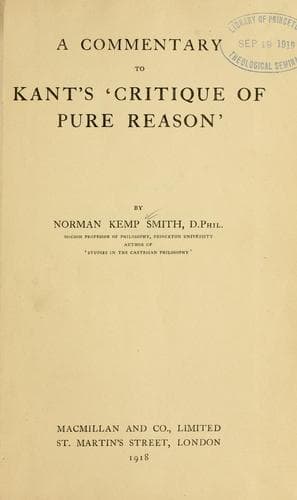
A Commentary to Kant's 'Critique of Pure Reason'Smith, Norman Kemp
Philosophy
A Commentary to Kant's 'Critique of Pure Reason'
Smith, Norman Kemp
Kant, Immanuel, 1724-1804. Kritik der reinen Vernunft
This sentence occurs in a passage which is undoubtedly a later
interpolation.[677] The “scarcely ever” (_selten nur einmal_) indicates
Kant’s lingering reluctance to recognise this fundamental fact,
destructive of so much in his earlier views, even though it completes
and reinforces his chief ultimate conclusions. With this admission Kant
also gives up his sole remaining ground for the contention that there
must be a complete parallelism between discursive and creative thinking.
If they arise from such different sources, we have no right to assume,
without specific proof, that they must coincide in the forms of their
activity. This is a point to which we shall return in discussing Kant’s
formulation of the principle which is supposed to guarantee the
completeness of the table of categories.
This unavowed change in point of view is the main cause of confusion in
this section. Its other defects are chiefly those of omission. Kant
fails to develop in sufficient detail his view of the nature of the
discursive concept, or to make sufficiently clear the grounds for his
assertion that conception as an activity of the understanding is
identical with judgment. To take the former point first. Kant’s mode of
viewing the discursive concept finds expression in the following passage
in the _Introduction_ to his _Logic_:[678]
“Human knowledge is on the side of the understanding _discursive_;
that is, it takes place by means of ideas which make what is common
to many things the ground of knowledge: and hence by means of
attributes as such. We therefore cognise things only by means of
attributes. An attribute is that in a thing which constitutes part
of our cognition of it; or, what is the same, a partial conception
so far as it is considered as a ground of cognition of the whole
conception. _All our concepts, therefore, are attributes, and all
thought is nothing but conception by means of attributes._”
The limitations of Kant’s view of the concept could hardly find more
definite expression. The only type of judgment which receives
recognition is the categorical, interpreted in the traditional
manner.[679]
“To compare something as a mark with a thing, is called ‘to judge.’
The thing itself is the subject, the mark [or attribute] is the
predicate. The comparison is expressed by the word ‘is,’ ... which
when used without qualification indicates that the predicate is a
mark [or attribute] of the subject, but when combined with the sign
of negation states that the predicate is a mark opposed to the
subject.”[680]
Public-domain text, read in full here on John Shaqi.
Reviews
Reviews
No reviews yet
Be the first to share your thoughts on this work.
Elsewhere in the archive
Join the Discussion
Join the discussion
Sign in to leave a comment or review.
Sign InorCreate an account