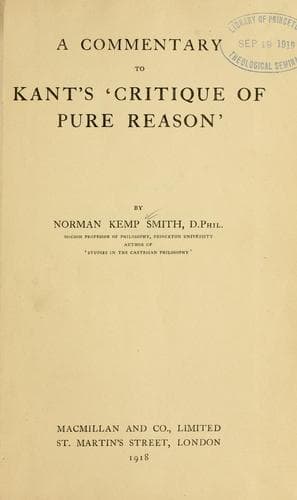
A Commentary to Kant's 'Critique of Pure Reason'Smith, Norman Kemp
Philosophy
A Commentary to Kant's 'Critique of Pure Reason'
Smith, Norman Kemp
Kant, Immanuel, 1724-1804. Kritik der reinen Vernunft
it is quite evident that the completeness of a concept and its
distinctness do not require different faculties of the mind (since
the same capacity which recognises something immediately as an
attribute in a thing is also employed to recognise in this
attribute another attribute, and thus to conceive the thing by
means of a remote attribute), so also it is evident that
understanding and reason, that is, the power of cognising
distinctly and the power of forming ratiocinations, are not
different faculties. Both consist in the power of judging, but when
we judge mediately we reason.”[682]
In the section before us this same standpoint is maintained, but is
expressed in a much less satisfactory manner. Concepts are no longer
spoken of as complete judgments. In the above passages Kant always
speaks of the concept as the subject of the proposition; it is now
treated only as a predicate.[683] This difference is significant. The
concept as subject can represent the judgment as a whole (or at least it
does so from the traditional standpoint to which Kant holds); the
concept as predicate is merely one element, even though it be a unifying
element, in the total act of judging. This falling away from his own
maturer standpoint would seem to be due to Kant’s lack of clearness as
to the nature of the analogy which he is here drawing between analytic
and synthetic thinking. It is connected with his mistaken, and merely
temporary, comparison of _a priori_ with discursive concepts. His
position in 1762 alone harmonises with his essential teaching. Now, as
then, he is prepared to view judgment as the sole ultimate activity of
the understanding, and therefore to define understanding as the faculty
of judging.
Public-domain text, read in full here on John Shaqi.
Reviews
Reviews
No reviews yet
Be the first to share your thoughts on this work.
Elsewhere in the archive
Join the Discussion
Join the discussion
Sign in to leave a comment or review.
Sign InorCreate an account