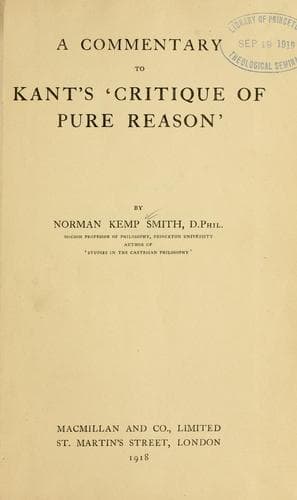
A Commentary to Kant's 'Critique of Pure Reason'Smith, Norman Kemp
Philosophy
A Commentary to Kant's 'Critique of Pure Reason'
Smith, Norman Kemp
Kant, Immanuel, 1724-1804. Kritik der reinen Vernunft
=4. Modality.=--Neither Wolff nor Reimarus gives any account of
modality.[706] Baumgarten classifies judgments as pure or modal
(existing in _four_ forms, necessity, contingency, possibility,
impossibility). Baumeister and Thomasius also recognise four forms of
modality. Meier distinguishes between pure judgment (_judicium purum_)
and impure judgment (_judicium modale_, _modificatum_, _complexum qua
copula_), but does not classify the forms of modality. Lambert
alone[707] classifies judgments as “possible, actual (_wirklich_),
necessary, and their opposite.” But when Kant adopts this threefold
division, the inclusion of actuality renders the general title
“modality” inapplicable in its traditional sense. The expression of
actuality in the assertoric judgment involves no adverbial modification
of the predicate. Also, in its “affirmative” and “categorical” forms it
has already been made to yield two other categories.
Kant speaks of the problematic, the assertoric, and the apodictic forms
of judgment as representing the stages through which knowledge passes in
the process of its development.
“These three functions of modality are so many momenta of thought
in general.”
This statement has been eulogised by Caird,[708] as being an
anticipation of the Hegelian dialectic. As a matter of fact, Kant’s
remark is irrelevant and misleading. The advance from consciousness of
the problematic, through determination of it as actual to its
explanation as necessary, represents only a psychological order in the
mind of the individual. Logically, knowledge of the possible rests on
and implies prior knowledge of the actual and of the necessities that
constitute the actual.[709]
Public-domain text, read in full here on John Shaqi.
Reviews
Reviews
No reviews yet
Be the first to share your thoughts on this work.
Elsewhere in the archive
Join the Discussion
Join the discussion
Sign in to leave a comment or review.
Sign InorCreate an account