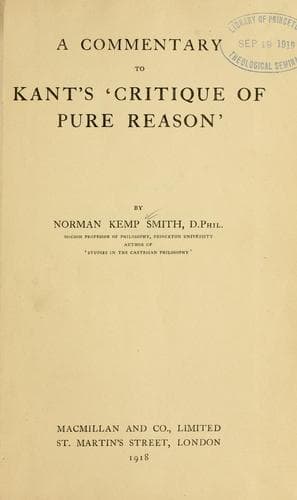
A Commentary to Kant's 'Critique of Pure Reason'Smith, Norman Kemp
Philosophy
A Commentary to Kant's 'Critique of Pure Reason'
Smith, Norman Kemp
Kant, Immanuel, 1724-1804. Kritik der reinen Vernunft
The accounts given of the metaphysical deduction by Cohen,[714]
Caird,[715] Riehl,[716] and Watson[717] are vitiated by failure to
remark that this latter standpoint is a late development, and is out of
keeping with the rest of the deduction. Riehl’s exposition has, however,
the merit of comparative consistency. He explicitly recognises the
important consequence which at once follows from acceptance of this
later view, namely, that it is by their implying space and time that the
categories differ from the notions which determine the forms of
judgment; in other words, that the _categories are actualised only as
schemata_. The category of substance, for instance, differs from the
merely logical notion of a propositional subject, in being the concept
of that which is _always_ a subject, and _never_ a predicate; and such a
conception has specific meaning for us only as the _permanent in time_.
Logical subjects and predicates, quantitative relations apart, are
interchangeable. The relation between them is the analytic relation of
identity. The concept of subject, on the other hand, transcendentally
viewed, that is, as a _category_, is the apprehension of what is
_permanent_, in synthetic distinction from, and relation to, its
changing attributes. In other words, the transcendental distinction
between _substance_ and _accidents_ is substituted for that of _subject_
and _predicate_. Similarly the logical relation of _ground_ and
_consequence_, conceived as expressive of logical identity, gives way to
the synthetic temporal relation of _cause_ and _effect_. And so with all
the other pure forms. As categories, they are schemata. Kant has
_virtually_ recognised this by the names which he gives to the
categories of relation. But the proper recognition of the necessary
interdependence of the intuitional and conceptual forms came too late to
prevent him from distinguishing between categories and schemata, and so
from creating for himself the artificial difficulties of the section on
schematism.
In A 82 Kant states that he intentionally omits definitions of the
categories. He had good reason for so doing. The attempt would have
landed him in manifold difficulties, since his views were not yet
sufficiently ripe to allow of his perceiving the way of escape. In A 241
(omitted in second edition) Kant makes, however, the directly counter
statement that definition of the categories is not possible, giving as
his reason that, in isolation from the conditions of sensibility, they
are merely logical functions, “without the slightest indication as to
how they can possess meaning and objective validity.”[718]
Public-domain text, read in full here on John Shaqi.
Reviews
Reviews
No reviews yet
Be the first to share your thoughts on this work.
Elsewhere in the archive
Join the Discussion
Join the discussion
Sign in to leave a comment or review.
Sign InorCreate an account