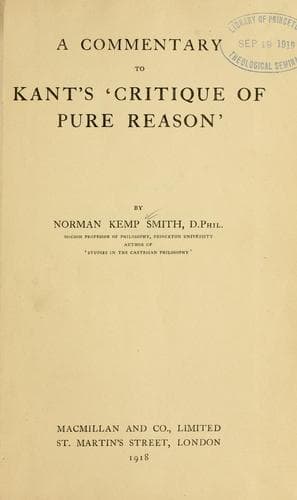
A Commentary to Kant's 'Critique of Pure Reason'Smith, Norman Kemp
Philosophy
A Commentary to Kant's 'Critique of Pure Reason'
Smith, Norman Kemp
Kant, Immanuel, 1724-1804. Kritik der reinen Vernunft
=Relation.=--The correlation of the categorical judgment with the
conception of substance and attribute is only possible[727] owing to
Kant’s neglect of the relational judgment and to the dominance in his
logical teaching of the Aristotelian substance-attribute view of
predication. The correlation is also open to question in that the
relation of subject and predicate terms in a logical judgment is a
reversible one. It is a long step from the merely grammatical subject to
the conception of that which is always a subject and never a predicate.
Kant’s identification of the category of community or reciprocity with
the disjunctive judgment, though at first sight the most arbitrary of
all, is not more so than many of the others. Its essential correctness
has been insisted upon in recent logic by Sigwart, Bradley, and
Bosanquet. In Kant’s own personal view[728] co-ordination in the form of
co-existence is only possible through reciprocal interaction. The
relation of whole and part (the parts in their relations of reciprocal
exclusion exhausting and constituting a genuine whole) thus becomes, in
its application to actual existences, that of reciprocal causation. The
reverse likewise holds; interaction is only possible between existences
which together constitute a unity.[729] Kant returns to this point in
_Note_ 3, added in the second edition.[730] The objection which Kant
there considers has been very pointedly stated by Schopenhauer.
“What real analogy is there between the problematical determination
of a concept by disjunctive predicates and the thought of
reciprocity? The two are indeed absolutely opposed, for in the
disjunctive judgment the actual affirmation of one of the two
alternative propositions is also necessarily the negation of the
other; if, on the other hand, we think of two things in the
relation of reciprocity, the affirmation of one is also necessarily
the affirmation of the other, and _vice versa_.”[731]
The answer to this criticism is on the lines suggested by Kant. The
various judgments which constitute a disjunction do not, _when viewed as
parts of the disjunction_, merely negate one another; they mutually
presuppose one another in the total complex. Schopenhauer also fails to
observe that in locating the part of a real whole in one part of space,
we exclude it from all the others.[732]
=Modality.=--The existence of separate categories of modality seems
highly doubtful. The concepts of the possible and of the probable may be
viewed as derivative; the notion of existence does not seem to differ
from that of reality; and necessity seems in ultimate analysis to reduce
to the concept of ground and consequence. These are points which will be
discussed later.[733]
Public-domain text, read in full here on John Shaqi.
Reviews
Reviews
No reviews yet
Be the first to share your thoughts on this work.
Elsewhere in the archive
Join the Discussion
Join the discussion
Sign in to leave a comment or review.
Sign InorCreate an account