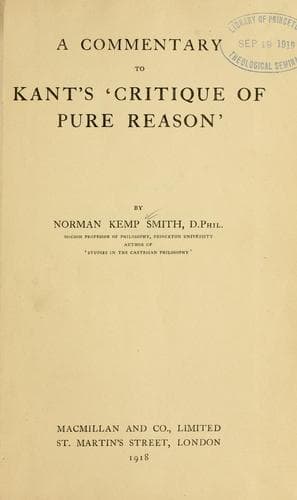
A Commentary to Kant's 'Critique of Pure Reason'Smith, Norman Kemp
Philosophy
A Commentary to Kant's 'Critique of Pure Reason'
Smith, Norman Kemp
Kant, Immanuel, 1724-1804. Kritik der reinen Vernunft
=B 113-16, § 12.=--This section, of no intrinsic importance, is an example
of Kant’s loving devotion to this “architectonic.” His reasoning is
extremely artificial, especially in its attempt to connect “unity,
truth, and perfection” with the three categories of quantity. The
_Reflexionen_ show how greatly Kant was preoccupied with these three
concepts, seeking either to base a table of categories upon them (B.
Erdmann’s interpretation), or to reduce them to categories (Adickes’
interpretation). For some time Kant himself ranked with those who[747]
“incautiously made these criteria of thought to be properties of the
things in themselves.” In _Reflexionen_, ii. 903,[748] we find the
following statement: “Unity (connection, agreement), truth (quality),
completeness (quantity).” In ii. 916[749] Kant makes trial to connect
them, as conceptions of possibility, with the categories of relation. In
ii. 911 and 912 the later view, that they are logical in character and
function, appears, but leads to their being set in relation to the three
faculties of understanding, judgment, and reason. This is conjectured
by B. Erdmann to have been Kant’s view at the time of the first edition.
ii. 915, 919, 920 present the view expounded in the section before
us.[750] Erdmann[751] remarks that in this section Kant “is settling
accounts with certain thoughts which in the ’seventies had yielded
suggestions for the transformation of ontology into the transcendental
analytic.”
CHAPTER II
DEDUCTION OF THE PURE CONCEPTS OF THE UNDERSTANDING
Public-domain text, read in full here on John Shaqi.
Reviews
Reviews
No reviews yet
Be the first to share your thoughts on this work.
Elsewhere in the archive
Join the Discussion
Join the discussion
Sign in to leave a comment or review.
Sign InorCreate an account