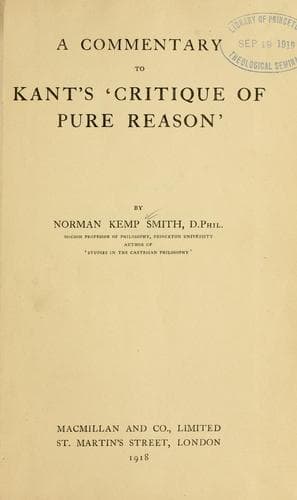
A Commentary to Kant's 'Critique of Pure Reason'Smith, Norman Kemp
Philosophy
A Commentary to Kant's 'Critique of Pure Reason'
Smith, Norman Kemp
Kant, Immanuel, 1724-1804. Kritik der reinen Vernunft
about these objects agree with the latter, when this agreement has
not been in any way assisted by experience? In mathematics such
procedure is legitimate, because its objects only _are_ quantities
for us, and can only be represented as quantities, in so far as we
can generate their representation by repeating a unit a number of
times. Hence the concepts of quantity can be self-producing, and
their principles can therefore be determined _a priori_. But when
we ask how the understanding can form to itself completely _a
priori_ concepts of things in their _qualitative_ determination,
with which these things must of necessity agree, or formulate in
regard to their possibility principles which are independent of
experience, but with which experience must exactly conform,--we
raise a question, that of the origin of the agreement of our
faculty of understanding with the things in themselves, over which
obscurity still hangs.”[808]
The section before us represents the same general standpoint as that
given in the above letter. Here, too, it is the validity of the _a
priori_ concepts in reference to _things in themselves_ that is under
consideration. The implication of Kant’s argument is that the
categories, being neither determinable nor discoverable by means of
experience, will only apply to appearances if they determine, or rather
reveal, the actual non-experienced nature of things in themselves. These
pure concepts, it is implied, owing to their combined _a priori_ and
intellectual characteristics, make this inherent claim. Either they are
altogether empty and illusory, or such unlimited validity must be
granted to them. Kant, that is to say, still holds, as in the
_Dissertation_, that sense-representations reveal things as they
_appear_, intellectual representations things as they _are_.
“We have either to surrender completely all claims to judgments of
pure reason, in the most esteemed of all fields, that which extends
beyond the limits of all possible experience, or we must bring this
Critical investigation to perfection.”[809]
The pure concepts, unlike space, “apply to objects generally, apart from
the conditions of sensibility.”[810] But here also, as in the letter to
Herz, the strange and problematic character of such knowledge is clearly
recognised.
Public-domain text, read in full here on John Shaqi.
Reviews
Reviews
No reviews yet
Be the first to share your thoughts on this work.
Elsewhere in the archive
Join the Discussion
Join the discussion
Sign in to leave a comment or review.
Sign InorCreate an account