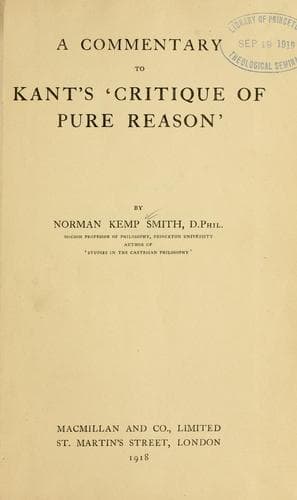
A Commentary to Kant's 'Critique of Pure Reason'Smith, Norman Kemp
Philosophy
A Commentary to Kant's 'Critique of Pure Reason'
Smith, Norman Kemp
Kant, Immanuel, 1724-1804. Kritik der reinen Vernunft
We may at this point consider Kant’s doctrine of “objective affinity.”
It excellently enforces the main thesis which he is professing to
establish, namely, that the conditions of _unitary_ consciousness are
the conditions of _all_ consciousness. The language, however, in which
the doctrine is expounded is extremely obscure and difficult; and before
commenting upon Kant’s own methods of statement, it seems advisable to
paraphrase the argument in a somewhat free manner, and also to defer
consideration of the transcendental psychology which Kant has employed
in its exposition.[898] Association can subsist only between ideas, both
of which have occurred within the same conscious field. Now the
fundamental characteristic of consciousness, the very condition of its
existing at all, is its unity; and until this has been recognised, there
can be no understanding of the associative connection which arises under
the conditions which consciousness supplies. To attempt to explain the
unity of consciousness through the mechanism of association is to
explain an agency in terms of certain of its own effects. It is to
explain the fundamental in terms of the derivative, the conditions in
terms of what they have themselves made possible. Kant’s argument is
therefore as follows. Ideas do not become associated merely by
co-existing. They must occur together in a unitary consciousness; and
among the conditions necessary to the possibility of association are
therefore the conditions of the possibility of experience. Association
is transcendentally grounded. So far from accounting for the unity of
consciousness, it presupposes the latter as determining the conditions
under which alone it can come into play.
“...how, I ask, is association itself possible?... On my principles
the thorough-going affinity of appearances is easily explicable.
All possible appearances belong as representations to the totality
of a possible self-consciousness. But as this self-consciousness is
a transcendental representation, numerical identity is inseparable
from it and is _a priori_ certain. For nothing can come to our
knowledge save in terms of this original apperception. Now, since
this identity must necessarily enter into the synthesis of all the
manifold of appearances, so far as the synthesis is to yield
empirical knowledge, the appearances are subject to _a priori_
conditions, with which the synthesis of their apprehension must be
in complete accordance.... Thus all appearances stand in a
thorough-going connection according to necessary laws, and
therefore in a transcendental affinity of which the empirical is a
mere consequence.”[899]
Public-domain text, read in full here on John Shaqi.
Reviews
Reviews
No reviews yet
Be the first to share your thoughts on this work.
Elsewhere in the archive
Join the Discussion
Join the discussion
Sign in to leave a comment or review.
Sign InorCreate an account