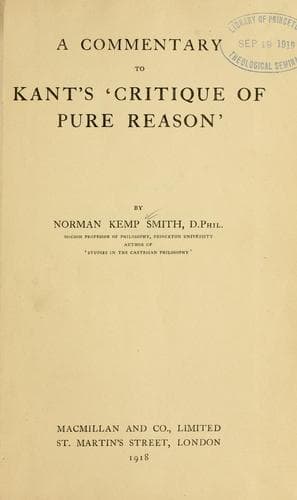
A Commentary to Kant's 'Critique of Pure Reason'Smith, Norman Kemp
Philosophy
A Commentary to Kant's 'Critique of Pure Reason'
Smith, Norman Kemp
Kant, Immanuel, 1724-1804. Kritik der reinen Vernunft
“This [objective ground of all association of appearances] can
nowhere be found, except in the principle of the unity of
apperception in respect of all forms of knowledge which can belong
to me. In accordance with this principle all appearances must so
enter the mind, or be so apprehended, that they fit together to
constitute the unity of apperception. This would be impossible
without synthetic unity in their connection, and that unity is
therefore also objectively necessary. The objective unity of all
empirical consciousness in one consciousness, that of original
apperception, is therefore the necessary condition of all (even of
all _possible_) perception; and the affinity of all appearances,
near or remote, is a necessary consequence of a synthesis in
imagination which is grounded _a priori_ on rules.”[902]
The fundamental characteristic of consciousness is the unified form in
which alone it can exist; only when this unity is recognised as
indispensably necessary, and therefore as invariably present whenever
consciousness exists at all, can the inter-relations of the contents of
consciousness be properly defined.
If this main contention of the Critical teaching be accepted, Hume’s
associationist standpoint is no longer tenable. Association cannot be
taken to be an ultimate and inexplicable property of our mental states.
Nor is it a property which can be regarded as belonging to presentations
viewed as so many independent existences. It is conditioned by the unity
of consciousness, and therefore rests upon the “transcendental”
conditions which Critical analysis reveals. Since the unity of
consciousness conditions association, it cannot be explained as the
outcome and product of the mechanism of association.
In restating the objective deduction in the second edition, Kant has
omitted all reference to this doctrine of objective affinity. His
reasons for this omission were probably twofold. In the first place, it
has been expounded in terms of a transcendental psychology, which, as we
shall find, is conjectural in character. And secondly, the phrase
“objective affinity” is, as I have already pointed out, decidedly
misleading. It seems to imply that Kant is postulating, without
independent proof, that noumenal conditions must be such as to supply an
orderly manifold of sense data. But though the doctrine of objective
affinity is eliminated, its place is to some extent taken[903] by the
proof that all apprehension is an act of judgment and therefore involves
factors which cannot be reduced to, or explained in terms of,
association.
Public-domain text, read in full here on John Shaqi.
Reviews
Reviews
No reviews yet
Be the first to share your thoughts on this work.
Elsewhere in the archive
Join the Discussion
Join the discussion
Sign in to leave a comment or review.
Sign InorCreate an account