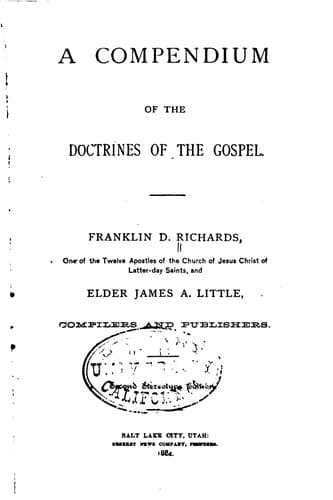
Church of Jesus Christ of Latter-day Saints -- Doctrines
The apostle Paul exhorted the Colossians to "be not moved away from
the hope of the Gospel, which ye have heard, and which was preached to
every creature which is under heaven;" _Col_. 1. 23.
About fifty-seven years after the Savior had closed his earthly
mission, if we are correctly informed in the second and third chapters
of the Revelations of St. John, there were but seven churches in Asia
whom the Lord considered worthy of notice. This, coupled with the
assertion of Paul, that the Gospel had, in his day, been preached to
every creature, proves that its light only faintly glimmered, in the
otherwise universal darkness, which existed at the time John had his
vision on the isle of Patmos.
John the Revelator saw Rome in all her glory, in his day, reigning over
the kings of the earth, full of riches and all manner of abominations,
and drunken with the blood of the Saints and of the martyrs of Jesus;
_Rev_. 17. This great power, drenched in the blood of the martyrs,
about 325 A.D., in the reign of Constantine, adopted what was then
known as Christianity, as the religion of the empire.
It was not possible that such a wicked, corrupt element and the Gospel
of Jesus could have any affinity. Rather, is it not evident that the
antagonism of Christianity and paganism had measurably ceased? that
they had assimilated? that they had both so nearly found the same
level, that with a slight pressure of governmental policy they readily
amalgamated?
Not only prophecy but general history, and especially the history of
Christianity by its learned professors, furnish abundant evidence of
its early departure from the pure principles of the Gospel.
The prophetic history of the preparatory work, for the coming of Christ
to reign on the earth in the latter days, is predicated on the apostacy
of the primitive Christian church, the general wickedness of the
nations, and the gathering of the house of Israel.
Since the calling of Abraham, the authenticated personal manifestations
of the Lord to man have been through him and his family. Christ came
to his own chosen people. His earthly mission was commenced and
consummated in the midst of Israel. The Gospel was first preached to
the Jews. His apostles were chosen from his brethren of the seed of
Abraham. The first church of Christ was established at Jerusalem. The
apostles were commanded to remain there until endowed with power from
on high. All the blessings of salvation are promised to mankind through
the seed of Abraham.
When the Lord comes in glory and power, the prophets inform us that he
will come to Zion and Jerusalem, the chief cities of gathered Israel.
The apostle Paul informs us that "God hath set some in the church,
first apostles, secondarily prophets, thirdly teachers, after that
miracles, then gifts of healings, helps, governments, diversities of
tongues;" 1 _Cor_. 12. 28.
Public-domain text, read in full here on John Shaqi.
Reviews
Reviews
No reviews yet
Be the first to share your thoughts on this work.
Elsewhere in the archive
Join the Discussion
Join the discussion
Sign in to leave a comment or review.
Sign InorCreate an account