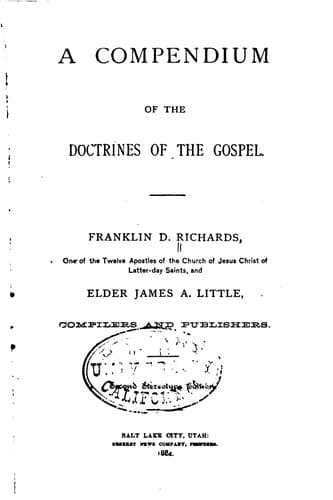
Church of Jesus Christ of Latter-day Saints -- Doctrines
_Page_ 3. in a day when men would take many of the words from the book
which Moses should write, the Lord promised to raise up another like
him, when they should be had again among men. 2 _Nephi_ 3. 9.
21. so will I come in the last days, in the days of wickedness and
vengeance.
_See O. Spencer's Letters to Rev. Wm. Crowel, No. 6_.
"_Universal Apostacy," a pamphlet by O. Pratt_.
THE JERUSALEM OF THE EASTERN HEMISPHERE.
The earliest account we have of Jerusalem is in the fourteenth chapter
of Genesis, under the date of 1913 B. C.
When Abram was returning from the slaughter of the five kings,
Melchisedek, king of Salem, brought him refreshments. He was a
righteous prince and a priest of the Most High God; and he blessed
Abram.
Josephus, the Jewish historian, states that this city of Salem was
afterwards called Jerusalem; _Ant. of the Jews, B_. 1., _Chapter_ 10.
It has been the scene of many great events connected with the ministry
of the holy Priesthood on the earth.
Abram was commanded to offer his son Isaac, on one of the mountains in
the land of Moriah; _Gen_. 22. 2. Josephus says, that the mountain on
which Abram built an altar, to offer his son Isaac, was the same on
which king David (Solomon) afterwards built a temple.
The Jebusites retained possession of the city of Jerusalem until 1048
B. C., when it was subdued by David. He first took the stronghold of
Zion; "The same is the city of David." At that time, this was only a
strong outwork or fortification for the defence of the city; 2 _Sam_.
5. 6-9.
In the days of Solomon, Jerusalem became a great and strong city, with
a magnificent temple towering on Mount Moriah.
From its conquest by David, until the death of Solomon, it was the
capital city of Israel, and afterwards of the kingdom of Judah. B. C.
585, Jerusalem was burned by the army of Nebuchadnezzar, and the better
part of the inhabitants of the land were carried captive to Babylon; 3
_Kings_, _chapters_ 24 and 25.
The city was re-established at the end of the seventy years' captivity.
It afterwards played an important part in the history of that part of
Asia.
Almost under the shadow of its walls, our Savior was born. It was
the central place of the scenes of his earthly mission. In it he was
scourged and condemned to death. Just outside of its walls, and in
sight of its towers, and the glorious temple built to his name, the God
of Israel died the death of a malefactor.
It was here, and near here, that he consummated his earthly mission,
and ascended to his Father.
In A. C. 70, the land of Judea, and city of Jerusalem, were made a
desolation by the Roman armies, and the Jews, as a nation, entirely
rooted out of their heritage, and scattered among all nations.
For information on this subject, the student should read, carefully,
Josephus' "_Wars of the Jews_."
Public-domain text, read in full here on John Shaqi.
Reviews
Reviews
No reviews yet
Be the first to share your thoughts on this work.
Elsewhere in the archive
Join the Discussion
Join the discussion
Sign in to leave a comment or review.
Sign InorCreate an account