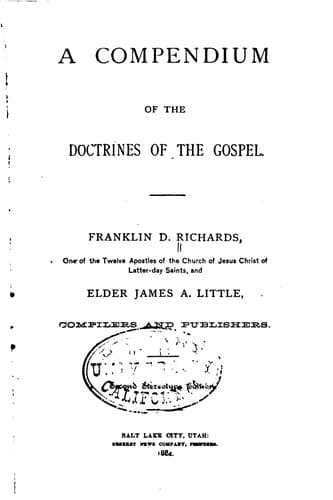
Church of Jesus Christ of Latter-day Saints -- Doctrines
In the second and third verses of the second chapter, we learn that
there was a period of time called the seventh day, and that the Lord
sanctified it as a day of rest. If there has ever been a period of
time in which this earth, or its inhabitants, have had universal peace
and rest, since the progenitors of the race partook of the forbidden
fruit in the Garden of Eden, we have no account of it. "These are the
generations of the heavens and of the earth when they were created,
in the day that the Lord God made the earth and the heavens;" _verse_
4. This passage certainly states, that everything had been completed
in the period of time stated in the previous account. Verse five very
plainly states, in connection with the previous verse, that every plant
of the field was created, "Before it was in the earth, and every herb
of the field before it grew." During all this long period of time it
had not rained upon the earth. What is still more singular, it says,
"And there was not a man to till the ground."
This Mosaic history of the creation was written for men in their
present temporal condition, and it is evident that these two verses
give us to understand, that these things had not taken place naturally
upon the earth, as they do now. As a sequence, when they did take
place, they would indicate a great change in the condition of the
earth. The first indication of this change is given in the sixth verse,
"There went up a mist from the earth and watered the whole face of the
ground."
Before the event mentioned in the seventh verse, the earth must have
been fitted up for the abode of man, in this his natural or temporal
condition. "And the Lord God formed man of the dust of the ground,
and breathed into his nostrils the breath of life." That is, the
ground furnished the elements for the growth of the body of this first
temporal man; from its first conception, or germ, until it matured into
perfect manhood by a universal law.
It should be noticed, that, in the first chapter, _verse_ 27, it says,
"God created man." That is he organized from the spiritual elements,
the living, acting spiritual man. In the seventh verse of the second
chapter, it only states that he formed man out of the ground. That is
out of earthly elements he formed a tabernacle, a dwelling place for
the man whom he had before created. The prophet Joseph Smith, in his
translation of the Mosaic account of creation, fills up this gap, which
is so evident in the Bible Genesis, between the seventh day of rest,
and the formation of man from the dust of the ground.
Public-domain text, read in full here on John Shaqi.
Reviews
Reviews
No reviews yet
Be the first to share your thoughts on this work.
Elsewhere in the archive
Join the Discussion
Join the discussion
Sign in to leave a comment or review.
Sign InorCreate an account