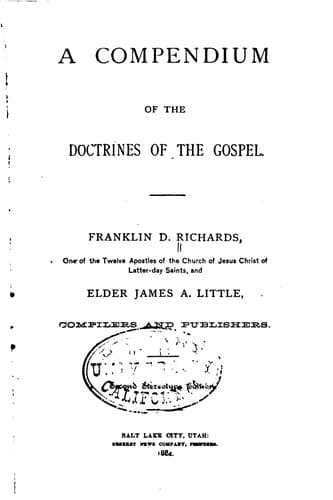
Church of Jesus Christ of Latter-day Saints -- Doctrines
"If the doctrinal part of the Book of Mormon be compared with the
doctrines of the Bible, there will be found the same perfect harmony
which we find on the comparison of the prophetical parts of the two
books. Although there are many points of the doctrine of Christ that
are far more plain and definite in the Book of Mormon than in the
Bible, and many things revealed in relation to doctrine that never
could be fully learned from the Bible, yet there are not any items of
doctrine in the two sacred books that contradict each other, or clash
in the least.
"If the various books which enter into the collection, called the Book
of Mormon, be carefully compared with each other, there will be found
nothing contradictory in history, in prophecy, or in doctrine.
"If the miracles of the Book of Mormon be compared with the miracles of
the Bible, there cannot be found in the former anything that would be
more difficult to believe, than what we find in the latter.
"If we compare the historical, prophetical, and doctrinal parts of
the Book of Mormon, with the great truths of science and nature, we
find no contradictions--no absurdities--nothing unreasonable. The most
perfect harmony, therefore, exists between the great truths revealed
in the Book of Mormon, and all other known truths, whether religious,
historical, or scientific." _Divine Authenticity of B. of M., page_ 56.
A person educated in the doctrines and traditions of modern
Christianity, could not have written the Book of Mormon, for many of
its important doctrines do not agree with those of the Christian sects.
They do not believe in the ministry of angels, in miracles, in signs,
in dreams and in visions. The book had its origin in those things, much
of it is made up of an account of them.
Lehi, the most prominent patriarch of the aboriginal American race, was
warned by an angel that Jerusalem would be destroyed; 1 _Nephi_ 1. 11,
13. That he might not be destroyed with it, the Lord warned him in a
dream to take his family and depart into the wilderness; 2. 2. In the
nineteenth verse of this last chapter, the Lord spake to Nephi, and
blessed him on account of his great faith.
Nephi, who wrote the first two books of the Book of Mormon, had
wonderful visions and manifestations. An infidel, or deist, having no
faith in manifestations from God, could not have written the book;
equally impossible that it could have been written by a sectarian
Christian.
Was the Book of Mormon written for a romance? It would spoil the
interest of a work of fiction, for the writer to commence it with a
sketch of the plan of his story. Yet the two books of Nephi, which
commence the Book of Mormon, are a very plain, prophetic sketch of the
then future history of the people of America.
Public-domain text, read in full here on John Shaqi.
Reviews
Reviews
No reviews yet
Be the first to share your thoughts on this work.
Elsewhere in the archive
Join the Discussion
Join the discussion
Sign in to leave a comment or review.
Sign InorCreate an account