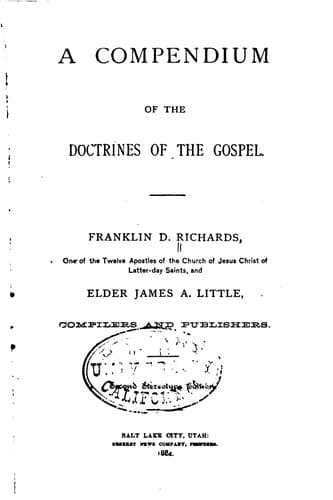
Church of Jesus Christ of Latter-day Saints -- Doctrines
The eighteenth chapter of Leviticus is chiefly occupied with forbidding
the unlawful indulgence of the passions. The Nephite prophet, Alma,
told his son that harlotry was "most abominable above all sins, save
it be the shedding of innocent blood;" _Alma_ 39, 5. Jesus told his
Nephite disciples "It is better that ye should deny yourselves of these
things, wherein ye will take up your cross, than that ye should be cast
into hell;" 3 _Nephi_ 12. 30.
In _Doc. & Cov_., the passages are numerous in which adultery is
forbidden. The Lord has given much instruction to the Latter-day Saints
concerning the intercourse of the sexes. They are required to keep
themselves strictly within their marriage covenants.
From the sacred writings, it would appear that in all dispensations of
the Priesthood, the laws regulating this matter have been substantially
the same, and have been calculated to strictly guard the issues of
life; that all those who would keep them might be "perfect in their
generations."
If, on the one hand, what the Lord does is eternal, because he is an
eternal and infinite being, then what man does of himself, he being
finite, must be limited to this life. Therefore, it is necessary that
man and wife, to be eternally united, should be married in the way God
has appointed, and by a man whom he has authorized to act in his stead.
It would not be consistent with the character of God, as the spiritual
and natural father of mankind, to have no law regulating the marriages
of his children, that they might be crowned with the blessings of
eternal life and increase.
The Lord brought Abraham forth abroad, "And said, Look now toward
heaven, and tell the stars, if thou be able to number them: and he said
unto him, So shall thy seed be;" _Gen_. 15. 5. This was a promise of
infinite and eternal increase. If we could count the stars, and grasp
infinitude, we might comprehend the result of the promise.
We find that the Lord confirmed blessings to Abraham, and to his seed,
by recorded ordinance and covenant. For this reason it is not probable
that a blessing of such magnitude, as the sealing upon man and wife the
power of eternal increase, is an exception. Abraham, in his own record,
translated by Joseph the Seer, says, "I sought for the blessings of the
fathers, and the right whereunto I should be ordained to administer the
same." One of these blessings was, "To be a father of many nations, a
prince of peace;" _P. of G. P., page_ 26.
Public-domain text, read in full here on John Shaqi.
Reviews
Reviews
No reviews yet
Be the first to share your thoughts on this work.
Elsewhere in the archive
Join the Discussion
Join the discussion
Sign in to leave a comment or review.
Sign InorCreate an account