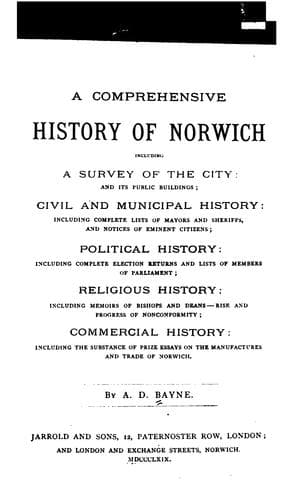
The Rev. Francis Blomefield, of Fersfield, who flourished in the first
half of the last century, was the chief of Norfolk historians and
antiquarians. He was great in genealogy and heraldry, and very elaborate
on monuments and epitaphs, while he altogether passed over more important
matters. We might almost wish that he had known less of heraldry and
more of history; but his great work must ever be the foundation of local
history in Norwich and Norfolk. A perfect copy of his work, being very
scarce, is now worth at least £20. It contains most of the documentary
antiquities of the city, such as charters, acts of parliaments,
proceedings of public bodies, and other official sources of information,
of which he has made a good use. He has given full details from the
records of every parish, and of the old corporation. He states the great
changes which took place in the city and county at the time of the
Reformation, and the dissolution of the monasteries, when nineteen of
those institutions existed in Norwich.
Blomefield notices several large conventual churches, which were
desecrated at the Reformation, and many parish churches which have been
demolished, their parishes being incorporated with those now existing.
* * * * *
ALL SAINTS’, situated in Fyebridge Street, was at the north corner of the
street called Cowgate, at its entrance into Magdalen Street, and was
built before the Conquest. At the foundation of the cathedral it was
appropriated to the convent, and at the Reformation to the dean and
chapter. It was said to have had a very fine font, erected in 1477. In
1550 the church was taken down, and the parish, with that of St.
Margaret, was annexed to St. Paul’s.
* * * * *
ST. BARTHOLOMEW’S, in Ber Street, was in the patronage of the prior of
Wymondham, and at the Dissolution was consolidated with St. John’s
Sepulchre, and the church taken down.
* * * * *
ST. BITTULPH’S stood in Magdalen Street, a little north of Stump Cross.
It was founded before 1300 and was taken down in 1548, and the parish
united to St. Saviour’s.
* * * * *
ST. CHRISTOPHER’S stood on the east side of St. Andrew’s Hill, and was
one of the oldest churches in the city. It was burnt down in the reign
of Henry III. The greater portion of the parish was united to St.
Andrew’s and a smaller part to St. Michael’s at Plea.
* * * * *
ST. CRUCIS, or St. Crowches, stood in Broad Street, St. Andrew’s. It was
dedicated to the honour of the holy cross, and was erected before the
year 1272. In 1551 it was desecrated, and the parish united to St.
John’s Maddermarket.
* * * * *
ST. CLEMENT’S, in Conisford, situated in King Street, was a very ancient
church, founded long before the Conquest. It was united with St.
Julian’s in 1482.
* * * * *
Public-domain text, read in full here on John Shaqi.
Reviews
Reviews
No reviews yet
Be the first to share your thoughts on this work.
Elsewhere in the archive
Join the Discussion
Join the discussion
Sign in to leave a comment or review.
Sign InorCreate an account