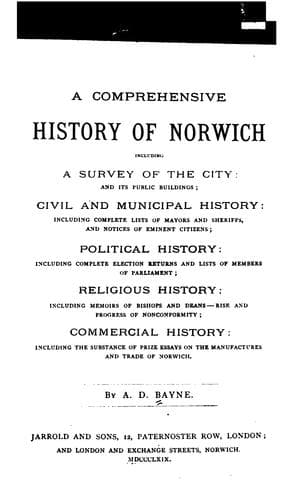
Such is the astounding statement in a local history printed by John
Crouse, in 1768. Where he got his “credible accounts” he does not say,
and he moreover gives the statement of the Domesday Book, that in 1086,
the city contained only 1565 burgesses; so that the population must have
increased in 250 years to a most fabulous extent, for 57,000 persons to
have died of the plague in 1348. In 1377, a census was taken of some
large towns, and Norwich was then found to contain 5300 people. But in
truth the number, 57,000, very probably applied to the whole diocese, for
the same local history states:—
“This severe visitation was not confined to the city alone, but
cruelly extended itself all over the diocese; so that in many
monasteries and religious houses, there were scarce two out of twenty
left alive. From the register book it appears that in the course of
the year there were 863 institutions. The clergy dying so fast, that
they were obliged to induct into livings numbers of youths who had
but just received the tonsure.”
The register in question was, no doubt, one of the whole diocese.
In 1361 there happened a great dearth, attended by the plague; this was
called the second pestilence. And on January 15th, in the same year,
there arose so furious a storm of wind from the south west, as to throw
down the tower of the cathedral, which falling on the choir demolished a
great part of it. The storm raged violently for six or seven days, and
was succeeded by a prodigious fall of rain, which occasioned incredible
damage by inundations. Where the inundations occurred is not stated in
the local history, but if in the city the damage must have been great
indeed.
In 1369, the plague broke out afresh and carried off great numbers of
people very suddenly. Yet in 1371, the citizens were commanded to
furnish the king with a good barge, sufficiently equipped for war to
serve against his enemies, the French and Spaniards. This does not
indicate that the city had been almost depopulated only a few years
before. Indeed, during all this time the citizens had been doing their
best by legal contests to hinder Yarmouth being made a staple town,
though they did not succeed.
About 1390 a great mortality broke out in the city, occasioned by the
people eating unwholesome food; and this not so much from a scarcity of
corn as of money to purchase it. The plague raged greatly in Norfolk and
in many other counties, and was nearly equal in severity to the first
great pestilence. So states the local narrative which we have just
quoted; and yet, according to the census of 1377, as already stated, the
population was only 5300! What reliance then can be placed on such
accounts? The calamities recorded were, no doubt, sufficiently awful
without the aid of exaggeration.
Public-domain text, read in full here on John Shaqi.
Reviews
Reviews
No reviews yet
Be the first to share your thoughts on this work.
Elsewhere in the archive
Join the Discussion
Join the discussion
Sign in to leave a comment or review.
Sign InorCreate an account