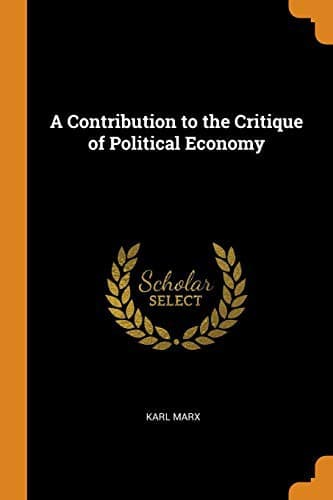
A Contribution to the Critique of Political EconomyMarx, Karl
Philosophy
A Contribution to the Critique of Political Economy
Marx, Karl
Economics; Marxian economics
What relation to production this distribution, which has a determining
influence on production itself, assumes, is plainly a question which
falls within the province of production. Should it be maintained
that at least to the extent that production depends on a certain
distribution of the instruments of production, distribution in that
sense precedes production and constitutes its prerequisite; it may
be replied that production has in fact its prerequisite conditions,
which form factors of it. These may appear at first to have a natural
origin. By the very process of production they are changed from natural
to historical, and if they appear during one period as a natural
prerequisite of production, they formed at other periods its historical
result. Within the sphere of production itself they are undergoing a
constant change. E. g., the application of machinery produces a change
in the distribution of the instruments of production as well as in that
of products, and modern land ownership on a large scale is as much the
result of modern trade and modern industry, as that of the application
of the latter to agriculture.
All of these questions resolve themselves in the last instance to this:
How do general historical conditions affect production and what part
does it play at all in the course of history? It is evident that this
question can be taken up only in connection with the discussion and
analysis of production.
Yet in the trivial form in which these questions are raised above,
they can be answered just as briefly. In the case of all conquests
three ways lie open. The conquering people may impose its own methods
of production upon the conquered (e. g. the English in Ireland in the
nineteenth century, partly also in India); or, it may allow everything
to remain as it was contenting itself with tribute (e. g. the Turks
and the Romans); or, the two systems by mutually modifying each other
may result in something new, a synthesis (which partly resulted
from the Germanic conquests). In all of these conquests the method
of production, be it of the conquerors, the conquered, or the one
resulting from a combination of both, determines the nature of the new
distribution which comes into play. Although the latter appears now
as the prerequisite condition of the new period of production, it is
in itself but a product of production, not of production belonging to
history in general, but of production relating to a definite historical
period. The Mongols with their devastations in Russia e. g. acted
in accordance with their system of production, for which sufficient
pastures on large uninhabited stretches of country are the main
prerequisite. The Germanic barbarians, with whom agriculture carried
on with the aid of serfs was the traditional system of production and
who were accustomed to lonely life in the country, could introduce
the same conditions in the Roman provinces so much easier since the
Public-domain text, read in full here on John Shaqi.
Reviews
Reviews
No reviews yet
Be the first to share your thoughts on this work.
Elsewhere in the archive
Join the Discussion
Join the discussion
Sign in to leave a comment or review.
Sign InorCreate an account