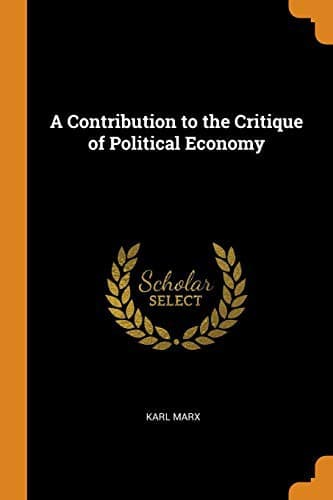
A Contribution to the Critique of Political EconomyMarx, Karl
Philosophy
A Contribution to the Critique of Political Economy
Marx, Karl
Economics; Marxian economics
In the study of economic categories, as in the case of every historical
and social science, it must be borne in mind that as in reality so
in our mind the subject, in this case modern bourgeois society, is
given and that the categories are therefore but forms of expression,
manifestations of existence, and frequently but one-sided aspects of
this subject, this definite society; and that, therefore, the origin of
[political economy] _as a science_ does not by any means date from the
time to which it is referred _as such_. This is to be firmly held in
mind because it has an immediate and important bearing on the matter of
the subdivisions of the science.
For instance, nothing seems more natural than to start with rent, with
landed property, since it is bound up with land, the source of all
production and all existence, and with the first form of production in
all more or less settled communities, viz. agriculture. But nothing
would be more erroneous. Under all forms of society there is a certain
industry which predominates over all the rest and whose condition
therefore determines the rank and influence of all the rest.
It is the universal light with which all the other colors are tinged
and are modified through its peculiarity. It is a special ether which
determines the specific gravity of everything that appears in it.
Let us take for example pastoral nations (mere hunting and fishing
tribes are not as yet at the point from which real development
commences). They engage in a certain form of agriculture, sporadically.
The nature of land-ownership is determined thereby. It is held in
common and retains this form more or less according to the extent to
which these nations hold on to traditions; such e. g. is land-ownership
among the Slavs. Among nations whose agriculture is carried on by a
settled population―the settled state constituting a great advance―where
agriculture is the predominant industry, such as in ancient and feudal
societies, even the manufacturing industry and its organization, as
well as the forms of property which pertain to it, have more or less
the characteristic features of the prevailing system of land ownership;
[society] is then either entirely dependent upon agriculture, as in the
case of ancient Rome, or, as in the middle ages, it imitates in its
city relations the forms of organization prevailing in the country.
Even capital, with the exception of pure money capital, has, in the
form of the traditional working tool, the characteristics of land
ownership in the Middle Ages.
Public-domain text, read in full here on John Shaqi.
Reviews
Reviews
No reviews yet
Be the first to share your thoughts on this work.
Elsewhere in the archive
Join the Discussion
Join the discussion
Sign in to leave a comment or review.
Sign InorCreate an account