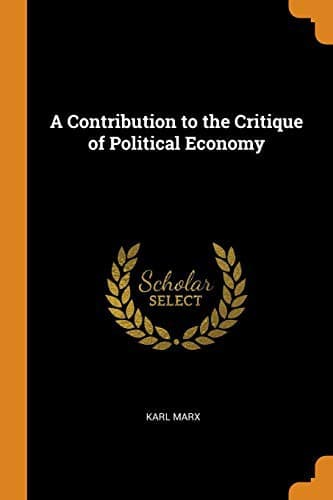
A Contribution to the Critique of Political EconomyMarx, Karl
Philosophy
A Contribution to the Critique of Political Economy
Marx, Karl
Economics; Marxian economics
[17] Petty had illustrated the productive power inherent in the
division of labor on a much grander scale than that was done later by
Adam Smith. See his “Essay concerning the multiplication of mankind,
etc.,” 3rd edition, 1686, p. 35-36. He not only brings out the
advantages of the division of labor on the example of the manufacture
of a watch, as Adam Smith did later on that of a needle, but considers
also a city and an entire country from the point of view of a large
manufacturing establishment. The Spectator, of November 26, 1711,
refers to this “illustration of the admirable Sir William Petty.”
McCulloch is, therefore, mistaken when he supposes that the Spectator
confounded Petty with a writer forty years his junior. See McCulloch,
“The Literature of Political Economy, a classified catalogue,” London,
1845, p. 105. Petty is conscious of being the founder of a new science.
His method, he says, “is not yet very usual, for instead of using
only comparative and superlative Words, and intellectual Arguments,”
he has undertaken to speak “in Terms of Number, Weight or Measure;
to use only Arguments of Sense, and to consider only such Causes, as
have visible Foundations in Nature; leaving those that depend upon
the mutable Minds, Opinions, Appetites, and Passions of particular
Men, to the Consideration of others.” (Political Arithmetick, etc.,
London, 1699. Preface.) (A new edition of “The Economic Writings of Sir
William Petty,” edited by Chas. Henry Hull, has been published by the
University Press at Cambridge, 1899. The above passage will be found
in vol. I., p. 244. The further references are given to this new, more
accessible edition. Translator.) His wonderful keenness shows itself
e. g. in the proposal to transport “all the moveables and people of
Ireland, and of the Highlands of Scotland ... into the rest of Great
Britain.” Thereby much labor-time would be saved, the productivity of
labor increased, and “the King and his Subjects would thereby become
more Rich and Strong.” (Political Arithmetick, ch. 4, p. 285.) Or
in the chapter of his Political Arithmetic in which he proves that
England’s mission is the conquest of the world’s market at a time when
Holland still played the leading part as a trading nation and France
seemed to be on the way of becoming the ruling trading Power: “That the
King of England’s Subjects, have Stock competent and convenient, to
drive the Trade of the whole Commercial World” (l. c., ch. 10, p. 311).
“That the Impediments of England’s greatness are but contingent and
removable” (l. c., ch. 5, p. 298). A singular humor pervades all his
writings. Thus, he shows that it was by material means that Holland―at
that time the model country with English economists, just as England
is with continental economists to-day―conquered the world market
“without such Angelical Wits and Judgments, as some attribute to the
Hollanders” (l. c., p. 258). He advocates “Liberty of Conscience” as a
Public-domain text, read in full here on John Shaqi.
Reviews
Reviews
No reviews yet
Be the first to share your thoughts on this work.
Elsewhere in the archive
Join the Discussion
Join the discussion
Sign in to leave a comment or review.
Sign InorCreate an account