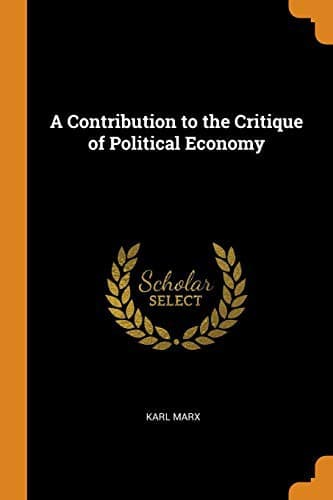
A Contribution to the Critique of Political EconomyMarx, Karl
Philosophy
A Contribution to the Critique of Political Economy
Marx, Karl
Economics; Marxian economics
by money, as it is pictured, amounts simply to this, that at all
points we observe its appearance and disappearance, its never ceasing
transition from place to place. In a higher, more involved form of
money circulation, e. g. bank-note circulation, we shall find that
the conditions of emission of money include those for its return. But
in the simple money circulation it is a matter of chance for the same
buyer to become again a seller. Where we really see constant cycle
motions taking place, they are only reflections of deeper forces in
the sphere of production, e. g., the manufacturer draws money from his
banker on Friday, pays it out to his working-men on Saturday, the men
immediately pay out the greater part of it to the storekeepers, etc.,
and the latter turn it in on Monday back to the banker.
We have seen that money realizes simultaneously a certain number of
prices in the variegated purchases and sales which take place side by
side at the same time. On the other hand, in so far as its movement
represents the movement of the combined metamorphoses of commodities
and the interlacing of these metamorphoses, the same coin realizes
the prices of different commodities and thus makes a larger or
smaller number of moves. If we take the circulation of a country for
a given length of time, say a day, the quantity of gold required for
the realization of prices and, consequently, for the circulation of
commodities, will be determined by two conditions: first, the sum
total of the prices; second, the average number of moves made by one
coin. This number of moves or the rapidity of circulation of money is
in its turn determined by or expresses the average rapidity with which
commodities go through the different phases of their metamorphoses, the
rapidity with which these metamorphoses succeed one another, and with
which those commodities that have gone through their metamorphoses are
replaced by new commodities in the process of circulation. We have seen
that in the process of the determination of prices the exchange value
of all commodities is ideally converted into a certain quantity of gold
of the same value and that the same amount of value is present in a
double form in either of the isolated acts of circulation M―C and C―M,
first embodied in the commodity, and second, in gold; yet gold enjoys
the capacity of a medium of circulation not by virtue of its isolated
relation to separate commodities in a state of rest, but owing to its
active presence in the dynamic world of commodities, viz., its function
of expressing the change of form of commodities by its change of place
and expressing the rapidity of their change of form by the rapidity of
its change of place. The extent to which it is present in the sphere
of circulation, i. e., the actual quantity of gold in circulation, is
thus determined by the extent to which it is discharging its function
throughout the entire process.
Public-domain text, read in full here on John Shaqi.
Reviews
Reviews
No reviews yet
Be the first to share your thoughts on this work.
Elsewhere in the archive
Join the Discussion
Join the discussion
Sign in to leave a comment or review.
Sign InorCreate an account