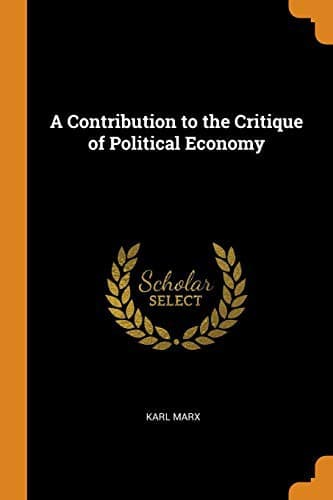
A Contribution to the Critique of Political EconomyMarx, Karl
Philosophy
A Contribution to the Critique of Political Economy
Marx, Karl
Economics; Marxian economics
The rise or fall of prices of commodities following a rise or fall
of the quantity of paper notes―the latter only where paper currency
constitutes the exclusive medium of circulation―is thus nothing but
an assertion through the process of circulation of a law mechanically
violated from without; namely, that the quantity of gold in circulation
is determined by the prices of commodities, and the quantity of tokens
of value in circulation is determined by the quantity of gold coin
which it represents. For that reason any desired number of paper notes
will be absorbed and equally digested by the process of circulation,
because the token of value, no matter with what gold title it may enter
circulation, will be compressed within the latter to a token of that
quantity of gold which could actually circulate in its place.
In the case of the circulation of tokens of value all laws pertaining
to the circulation of real money appear to be reversed and standing
on their heads. While gold circulates because it has value, paper has
value because it circulates. While with a given exchange value of
commodities, the quantity of gold in circulation depends on its own
value, the value of paper depends on its own quantity in circulation.
While the quantity of gold in circulation rises or falls with the
rise or fall of prices of commodities, the prices of commodities
seem to rise or fall with the change in the quantity of paper in
circulation. While the circulation of commodities can absorb only a
definite quantity of gold coin and as a result of that the alternating
contraction and expansion of the currency appears as a necessary law,
paper money seems to enter circulation in any desired amount. While
the state is guilty of debasing gold and silver coin and of disturbing
their function of a medium of circulation, if it turns out a coin,
only 1-100 of a grain below its nominal weight; it performs a perfectly
proper operation by issuing absolutely worthless paper notes which
contain nothing of the metal except its mint denomination. While gold
coin apparently represents the value of commodities only in so far as
that value is itself estimated in gold or is expressed in price, the
token of value seems to represent directly the value of commodities.
It is, therefore, clear why students who examined one-sidedly the
phenomena of circulation of money by confining their observations to
the circulation of legal tender paper money, should have failed to
grasp the intrinsic laws governing the circulation of money. As a
matter of fact, these laws appear not only reversed but extinct in the
circulation of tokens of value, since paper currency, if issued in
the right quantity, goes through certain movements which are not in
its nature as a token of value, while its proper movement instead of
growing directly out of the metamorphosis of commodities, springs from
the violation of its proper proportion to gold.
3. MONEY.
Public-domain text, read in full here on John Shaqi.
Reviews
Reviews
No reviews yet
Be the first to share your thoughts on this work.
Elsewhere in the archive
Join the Discussion
Join the discussion
Sign in to leave a comment or review.
Sign InorCreate an account