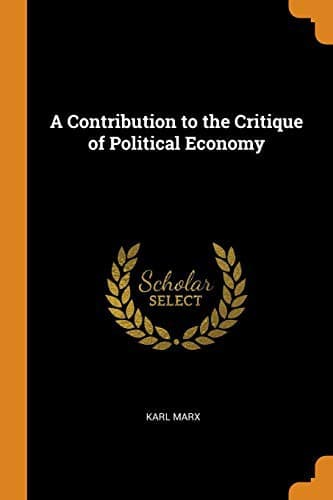
A Contribution to the Critique of Political EconomyMarx, Karl
Philosophy
A Contribution to the Critique of Political Economy
Marx, Karl
Economics; Marxian economics
Quite apart from their aesthetic properties, silver and gold
commodities are convertible into money, since the material of which
they are made is a money material; and, inversely, gold money and gold
bullion can be converted into commodities. Because gold and silver
constitute the material of abstract wealth, the greatest display
of wealth consists of the utilization of these metals as concrete
use-values, and if the owner of commodities hides his treasure at
certain stages of production, he is very anxious to appear before
other owners of commodities as _rico hombre_ whenever he can do so
with safety. He gilds himself and his house.[98] In Asia, especially
in India, where, unlike under the capitalist system, the hoarding
of wealth appears not as a subordinate function of the system of
production, but as an end in itself, gold and silver commodities are
practically but aesthetic forms of hoards. In mediaeval England gold
and silver commodities were considered before the law as mere forms of
treasure, since their value was but slightly increased by the crude
labor spent upon them. They were destined to re-enter circulation
and their fineness was therefore prescribed in the same manner as
that of coin. The increasing use of gold and silver as objects of
luxury with the growth of wealth is such a simple matter that it was
perfectly clear to the ancients,[99] while modern economists have
advanced the erroneous proposition that the use of silver and gold
articles increases not in proportion to the growth of wealth, but
in proportion to the fall in value of the precious metals. Their
otherwise accurate references to the use of Californian and Australian
gold are inconclusive, since the increased consumption of gold as a
raw material does not find justification, according to their theory,
in any corresponding decline in its value. From 1810 to 1830, in
consequence of the struggle of the American colonies against Spain and
the interruption of mining caused by revolutions, the annual average
production of precious metals declined by more than one-half. The
decline of coin in circulation in Europe amounted to nearly one-sixth,
comparing the years 1829 and 1809. Although the quantity produced had
thus declined and the cost of production, if it had changed at all,
had increased, yet the consumption of precious metals as objects of
luxury increased to an extraordinary extent in England during the very
war and on the continent after the Peace of Paris. The consumption
increased with the general growth of wealth.[100] It may be stated
as a general law that the conversion of gold and silver money into
articles of luxury prevails in times of peace, while their reconversion
into bullion or even coin takes place in stormy periods.[101] How
considerable the proportion is of the gold and silver treasure in the
form of articles of luxury to the quantity of precious metals serving
as money may be seen from the fact that in 1829 the proportion in
Public-domain text, read in full here on John Shaqi.
Reviews
Reviews
No reviews yet
Be the first to share your thoughts on this work.
Elsewhere in the archive
Join the Discussion
Join the discussion
Sign in to leave a comment or review.
Sign InorCreate an account