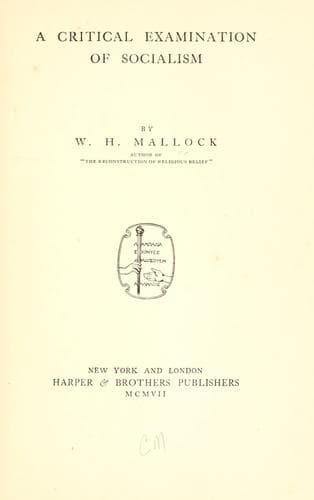
A Critical Examination of SocialismMallock, W. H. (William Hurrell)
Philosophy
A Critical Examination of Socialism
Mallock, W. H. (William Hurrell)
Communism; Socialism
Socialists, in short, of all schools, are socialists because they are
ignorant of, or fail to apprehend, certain facts or principles of nature
and of human nature which are essential to the complicated process of
modern productive industry; or it is perhaps a truer way of putting the
case to say that they could not be socialists unless they were thus
ignorant. In this they resemble the devisers of perpetual motions, or
scientific and infallible systems for breaking the bank at a
roulette-table. In so far as they are socialists--that is to say, in so
far as they differ from other reformers--they are men aiming at
something which is in its nature impracticable; and in order to
represent it to themselves and others as practicable, they must
necessarily ignore or fail to understand something which, in actual
life, stands in the way of its being so. The perpetual-motionist
believes that a perpetual motion is practicable, because he fails to see
that out of no machine whatever is it possible to get more force than is
put into it, and that one pound-weight will not wind up another. The
system-monger sees that if a succession of similar stakes are placed on
red or black, or any one of the thirty-six numbers, the bank always has
zero in its favour; but by placing a number of stakes simultaneously in
intricate combinations, or by graduating them according to results, he
imagines that he can invert the situation, when all he can do is to
disguise it. He often disguises it most effectually; but in the long run
he does no more. Like a protuberance in an air cushion, which if pushed
down in one place reappears in another, the original advantage of the
bank infallibly ends in reasserting itself. The system-monger fails to
see this for one reason only--that, having disguised, he thinks that he
has eliminated, a fundamental fact of the situation. Socialists, in so
far as they are socialists, reason in the same way. Though most of them
now recognise, like the author of "The Gospel for To-day," that the
economic efficiencies of men are in the highest degree unequal, they
propose out of an inequality of functions to produce an equality of
conditions. The details of the changes by which they propose to effect
this result, or the grounds on which they seek to represent this result
as possible, vary like the details of the systems of ingenious gamblers.
But whatever these details may be, whether they are details of scheme or
argument, the essential element of each is the omission of some
fundamental fact--or, rather, of one protean fact--by which socialistic
thinkers are often honestly confused, because it assumes, as they shift
their positions, any number of different aspects. This is the fact that
out of unequal men it is absolutely impossible to construct a society of
equals.
Public-domain text, read in full here on John Shaqi.
Reviews
Reviews
No reviews yet
Be the first to share your thoughts on this work.
Elsewhere in the archive
Join the Discussion
Join the discussion
Sign in to leave a comment or review.
Sign InorCreate an account