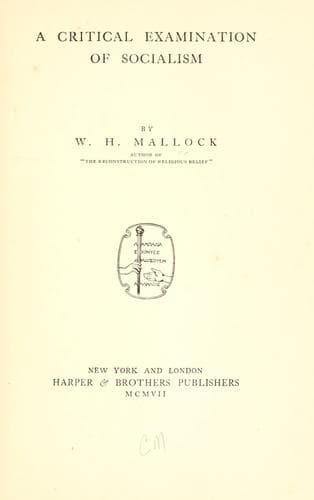
A Critical Examination of SocialismMallock, W. H. (William Hurrell)
Philosophy
A Critical Examination of Socialism
Mallock, W. H. (William Hurrell)
Communism; Socialism
At the end of an address in which I had been dealing with this subject
at New York, a young man, one of my hearers, told me that I had been
putting into words what had long been borne in on himself by his own
studies and observations--the fact, namely, that the social leaders of
men are divided into two classes, _those who dream about reforming the
industrial business of the world, and those, an opposite type, who alone
advance and accomplish it_. Here we have the conclusion of the whole
matter. These two classes are contrasted, not because in mere intellect
one is inferior to the other, but because when they are dealing with the
industrial affairs of life these affairs appeal to them in two
contrasted ways. One of these classes takes men and nature as they are.
With the utmost minuteness it masters the secrets of the latter, with
the utmost minuteness it directs the actions of the former; and in
seeking wealth for itself it brings about those conditions which alone
can make added wealth a practical possibility for all. The other class,
occupied not with what is but what ought to be, fails to understand what
can be, because it does not understand what is. The men of whom this
class is composed--the men whose temperamental deficiency now finds its
fullest expression in socialism, as it did formerly in theories of
ultra-democratic individualism, are like amateur architects, and amateur
sanitary engineers, who, thinking in pictures, and having no knowledge
of structure, condemn existing houses and existing systems of drainage,
and would replace them with palaces which no builder could build, with
arches which would collapse from the weight of their own materials, and
magnificent cloacae the waters in which would have to run uphill.
The theory, then, of socialism, let it take what form it will--the
theory which represents as practicable by one device or another the
social equalisation of economically unequal men--is a theory which, in
minds which are intellectually honest, can develop itself only in
proportion as these minds are incapable of grasping in their connected
completeness the actual facts of life; and that such is the case has
been illustrated in the preceding chapters by a systematic analysis of
all the crucial arguments on which socialists have rested their case
from the earliest day of socialistic thought to the latest.
Public-domain text, read in full here on John Shaqi.
Reviews
Reviews
No reviews yet
Be the first to share your thoughts on this work.
Elsewhere in the archive
Join the Discussion
Join the discussion
Sign in to leave a comment or review.
Sign InorCreate an account