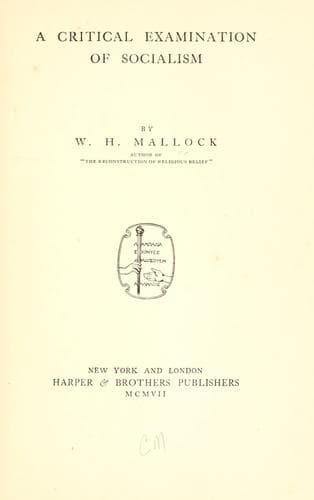
A Critical Examination of SocialismMallock, W. H. (William Hurrell)
Philosophy
A Critical Examination of Socialism
Mallock, W. H. (William Hurrell)
Communism; Socialism
When, with any practical purpose in view, we insist that anything is the
cause of anything else, or produces anything else, we are always
selecting, out of an incalculable number of causes, one cause or agency
which, under the circumstances in view, may or may not be present; which
a careless person may neglect to introduce; which an ignorant person may
be persuaded to take away; or a recognition of which will influence
human conduct somehow; while all other causes, which no one proposes to
take away, or which no one is able to take away, are assumed by all
parties, but they are not considered by anybody. Why should they be
considered? Not only are they so numerous that no intellect could deal
with them, but they have, since with regard to them there is no
difference of opinion, no place in any practical discussion at all. If a
ton of stone is to be placed on a piece of framework, men may reasonably
discuss whether the framework is strong enough to bear it, or whether
material is not being wasted in making it stronger than necessary. What
will happen without an additional girder? Or what will happen if we take
two girders away? Will the stone fall or not? These questions belong to
the domain of practical reasoning because to take a girder away, or else
introduce fresh ones, lies within the power of the disputants. But no
practical men would think of complicating the discussion by calculating
what would happen if they suspended the action of gravitation, in which
case the stone would need no support whatever; for to suspend the action
of gravitation is within the power of nobody. If two men are debating in
the middle of the night at midsummer whether there is enough oil in the
lamp to keep it alight till sunrise, they are debating a question of a
strictly practical kind: for it rests with them to put in more oil or
not. What will happen if they do not? That is the point at issue. But
they neither of them would debate what would happen if the movement of
the earth were retarded, and the midsummer morning were delayed till the
hour at which it dawns in winter. They do not discuss this contingency,
for they rightly assume it to be impossible, and consequently the
discussion of it would have no practical meaning.
And now let us go back to the question of labour and ability; and we
shall see, in the case of products to the production of which both are
essential, that, while ability is the practical cause of all such
amounts or values as exceed what would have been produced by labour if
there were no ability to direct it, it cannot be claimed in any similar
sense that all amounts and values are conversely produced by labour,
which exceed what would have been produced by the action of directive
ability, if no labour existed for such ability to direct.
Public-domain text, read in full here on John Shaqi.
Reviews
Reviews
No reviews yet
Be the first to share your thoughts on this work.
Elsewhere in the archive
Join the Discussion
Join the discussion
Sign in to leave a comment or review.
Sign InorCreate an account