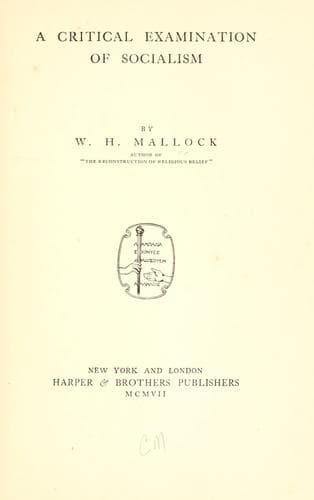
A Critical Examination of SocialismMallock, W. H. (William Hurrell)
Philosophy
A Critical Examination of Socialism
Mallock, W. H. (William Hurrell)
Communism; Socialism
So much, then, being settled, let us consider these further facts. Both
the capitalists, as we set out with observing, have in employing their
capital the same ultimate object--namely, that of securing through the
purchased efforts of others a continuous supply of things which will
render their lives agreeable. And now in connection with this fact let
us go back to another, which has also been pointed out before, that all
efforts, the sole object of which is to please from moment to moment the
man who directs and pays for them, are, whether embodied in the form of
commodities or no, really reducible to some kind of personal service,
if a toy-maker, in return for food, makes a dancing-doll for another
man, he might just as well have pirouetted for so many hours himself;
and if the purchaser would be more amused by a man's antics than by a
puppet's, this is precisely what the toy-maker would have been set to
do. In short, if we consider only the economic side of the matter,
without reference to the moral, whenever a man spends anything on his
own personal pleasure, he is virtually paying some other man, or a
number of other men to dance for him.[24] What, therefore, both our
capitalists desire as their ultimate object, is to keep as many men as
they are able to provide with food always dancing for their pleasure, or
in readiness to do so when wanted; but in setting themselves to achieve
this object in their two different ways, what happens is as follows.
Both use their capital by dispensing it in the form of daily rations to
two hundred other men, on condition that these men do something; but the
first feeds the other men, not on condition that they dance for him, or
do anything that ministers to his own immediate pleasure, but on
condition that they construct a machine which will enable, as soon as it
is finished, a given amount of human effort to double the amount of food
which such effort would have produced otherwise. Thus, by the end of two
years--the time which we suppose to be required for the machine's
completion--though the original food-supply of the capitalist will all
have been taken up and disappeared, its place will have been taken by a
machine which will enable forever afterwards one-half of the two hundred
men to produce food for the whole. A hundred men, therefore, are left
for whom food can be permanently provided, without any effort to produce
it being made by these men themselves; and since of this annual surplus
a part--let us call it half--will be taken as interest on the machine by
the man with whose capital it was constructed, he will now have the
means of making fifty men dance for his pleasure in perpetuity; for as
often as they have eaten up one supply of food, this, through the agency
of the machine, will have been replaced by another.
Public-domain text, read in full here on John Shaqi.
Reviews
Reviews
No reviews yet
Be the first to share your thoughts on this work.
Elsewhere in the archive
Join the Discussion
Join the discussion
Sign in to leave a comment or review.
Sign InorCreate an account