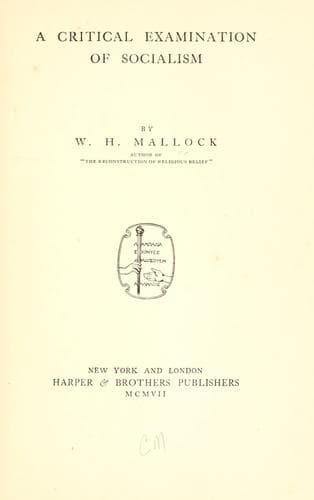
A Critical Examination of SocialismMallock, W. H. (William Hurrell)
Philosophy
A Critical Examination of Socialism
Mallock, W. H. (William Hurrell)
Communism; Socialism
similar process would be repeated in after-life. This policy, as has
been pointed out already, is, even if wasteful, not ruinous in the
sphere of ordinary labour--a fact which shows how wide the difference is
between the ordinary faculties, as applied to industry, and the
exceptional; but no one in his senses, not even the most ardent apostle
of equality, would dream of recommending its application to efforts of a
higher kind, and demand that the clever boys should periodically be made
to wait for the stupid, or that the best doctor in the presence of a
great pestilence should not be allowed to cure more patients than the
worst one.
If, then, it is, as it must be, the ideal aim of social arrangements
generally to enable each to raise his capacities to their practical
maximum, and adjust his desires and his expectations to the practical
possibilities of attainment, "relative equality of opportunity," firstly
in education and secondly in practical life, is a formula which
accurately expresses the means by which this end is to be secured; but
the absolute equality which is contemplated by socialists and others is
an ideal which, the moment we attempted to translate it into terms of
the actual, would begin to fall to pieces, defeating its own purpose;
and there is nothing in socialism, were socialism otherwise practicable,
any more than there is the existing system, which would obviate this
result.
Indeed, it may be observed further that, though the idea of equality of
opportunity in general is not inconsistent with a socialistic scheme of
society, as socialists of the more thoughtful kind have now come to
conceive of it, it belongs distinctively to the domain of the fiercest
individual competition. For in so far as socialism differs from ordinary
individualism, it differs from it in this--that, instead of encouraging
each man to do his utmost because what he gets will be proportionate to
what he does, it aims at establishing a greater equality in what men get
by making this independent of whether they do much or little; in which
case the main concern of the individual would be the certainty of
getting what he wanted, not the opportunity of producing it.
Public-domain text, read in full here on John Shaqi.
Reviews
Reviews
No reviews yet
Be the first to share your thoughts on this work.
Elsewhere in the archive
Join the Discussion
Join the discussion
Sign in to leave a comment or review.
Sign InorCreate an account