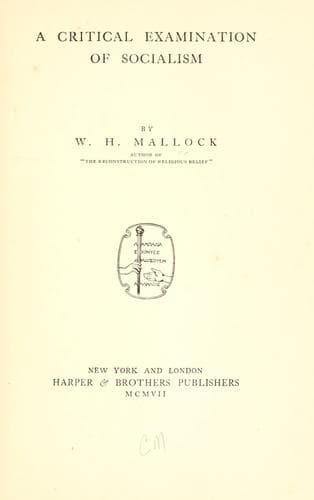
A Critical Examination of SocialismMallock, W. H. (William Hurrell)
Philosophy
A Critical Examination of Socialism
Mallock, W. H. (William Hurrell)
Communism; Socialism
Other writers, however, try to reach Mr. Kidd's conclusion by a
somewhat different route. Whether the great man is or is not a more
common phenomenon than he seems to be, they maintain that his conquests
in the realms of invention and discovery, when once made, really "become
common property," of which all men could take advantage if it were not
for artificial monopolies. All men, therefore, though not equal as
discoverers, are practically equalised by whatever the discoverers
accomplish. Now, of the simpler inventions and discoveries, such as that
of fire for example, this is perfectly true; but it is true of these
only. As inventions and discoveries grow more and more complex, they no
more become common property, as soon as certain men have made them, than
encyclopaedic knowledge becomes the property of every one who buys or
happens to inherit an edition of the _Encyclopaedia Britannica_. It is
perfectly true that the discovery of each new portion of knowledge
enables men to acquire it who might never have acquired it otherwise;
but as the acquisition of the details of knowledge becomes facilitated,
the number of details to be acquired increases at the same time; and the
increased ease of acquiring each is accompanied by an increased
difficulty in assimilating even those which are connected most closely
with each other. We may safely say that a knowledge of the simple rules
of arithmetic is common to all the members of the English University of
Cambridge; but out of some thousands of students only a few become great
mathematicians. And the same thing holds good of scientific knowledge
in general, and especially of such knowledge as applied to the purposes
of practical industry. Knowledge and inventions, once made, are like a
river which flows by everybody; but the water of the river becomes the
property of individuals only in proportion to the quantity of it which
their brains can, as it were, dip up; and the knowledge dipped up by the
small brains is no more equal to that dipped up by the large than a
tumbler of water is made equal to a hogshead by the fact that both
vessels have been filled from the same stream.
Public-domain text, read in full here on John Shaqi.
Reviews
Reviews
No reviews yet
Be the first to share your thoughts on this work.
Elsewhere in the archive
Join the Discussion
Join the discussion
Sign in to leave a comment or review.
Sign InorCreate an account