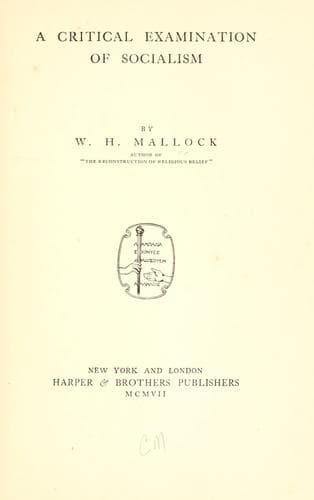
A Critical Examination of SocialismMallock, W. H. (William Hurrell)
Philosophy
A Critical Examination of Socialism
Mallock, W. H. (William Hurrell)
Communism; Socialism
Now, that the motives here in question are motives of extraordinary
power, all history shows us. The most impressive things accomplished by
human nature have been due to them. But let us consider what these
things are. The first motive--namely, that supplied by the mere
"pleasure in excelling"--we need hardly consider by itself, for, in so
far as socialists can look upon its objects as legitimate, it is
included in the struggle for approbation or honour. We will merely
remark that the emphasis which the socialists lay on it is not very
consonant with the principles of those persons who propose to abolish
competition as the root of all social evils; and we will content
ourselves with examining in detail the three other motives only, and the
scope of their efficiency, as actual experience reveals it to us.
We shall find that the activities which these three motives stimulate
are confined, so far as experience is able to teach us anything, to the
following well-marked kinds, which have been already indicated: those of
the artist, of the speculative thinker, of the religious and
philanthropic enthusiast, and, lastly, those of the soldier. This list,
if understood in its full sense, is exhaustive.
Such being the case, then, the argument of the socialists is as follows:
Because a Fra Angelico will paint a Christ or a Virgin, because a Kant
will immolate all his years to philosophy, because a monk and a sister
of mercy will devote themselves to the victims of pestilence, because a
soldier in action will eagerly face death--all without hope of any
exceptional pecuniary reward--the monopolists of business ability, if
only such rewards are made impossible for them, will at once become
amenable to the motives of the soldier, the artist, the philosopher, the
inspired philanthropist, and the saint. This is the assertion of the
socialists when reduced to a precise form; and what we have to do is to
inquire whether this assertion is true. Does human nature, as history,
as psychology, and as physiology reveal it to us, give us any grounds,
in fact, for taking such an assertion seriously? Any one who has studied
human conduct historically, who has observed it in the life around him,
and examined scientifically the diversities of temperament and motive
that go with diversities of capacity, will dismiss such an assertion as
at once groundless and ludicrous.
Public-domain text, read in full here on John Shaqi.
Reviews
Reviews
No reviews yet
Be the first to share your thoughts on this work.
Elsewhere in the archive
Join the Discussion
Join the discussion
Sign in to leave a comment or review.
Sign InorCreate an account