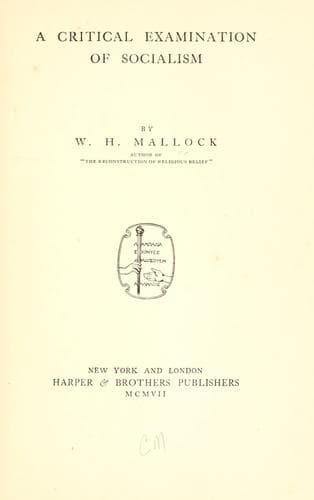
A Critical Examination of SocialismMallock, W. H. (William Hurrell)
Philosophy
A Critical Examination of Socialism
Mallock, W. H. (William Hurrell)
Communism; Socialism
We thus see that those thinkers who, when they are dealing with an
imaginary future, base all their hopes on the possibility of a complete
elimination of a certain motive from a certain special class of persons,
are the very men who are most vehement in declaring that in this special
class of persons the motive in question is something so ingrained and
inveterate that in no age or country has it ever been so much as
modified.
Nor does the matter end here; for the amusing contradiction in which
socialistic thought thus lauds itself, is emphasised by the fact that
the socialists, when they turn from the few to the many, assume in the
many, as an instinct of eternal justice, that precise desire for gain
which, in the case of the few, they first denounce as a hideous and
incurable disease, and then propose to cure as though it were the
passing cough of a baby. For what is the bait with which, from its first
beginnings till to-day, socialism has sought to secure the support of
the general multitude? It is mainly, if not solely, the promise of
increased personal gain, without any increased effort on the part of the
happy recipients. With Marx and the earlier socialists, this promise
took the form of declaring that every man has a sacred right to whatever
he has himself produced, and that, all the wealth of the world being
produced by manual labour, the labourers must never be satisfied until
they have secured all of it. The more educated socialists of to-day,
having gradually come to perceive that labour itself produces but a
fraction of this wealth only, have had to alter the form of their
promise, but they still adhere to its substance; and the altered form of
the promise does but bring out more clearly the fact that they appeal to
the desire of personal gain as the primary economic motive of the great
majority of mankind. For, whereas the earlier socialists contented
themselves with promising the labourer the whole of what he produced,
and promising it on the ground that he had himself produced it, what the
labourer is promised by the intellectual socialists of to-day is not
only all that he has produced--which in most cases he gets
already[14]--but a great deal more besides, which is admittedly produced
by others.
Public-domain text, read in full here on John Shaqi.
Reviews
Reviews
No reviews yet
Be the first to share your thoughts on this work.
Elsewhere in the archive
Join the Discussion
Join the discussion
Sign in to leave a comment or review.
Sign InorCreate an account