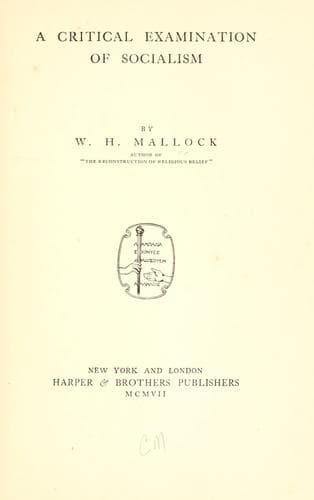
A Critical Examination of SocialismMallock, W. H. (William Hurrell)
Philosophy
A Critical Examination of Socialism
Mallock, W. H. (William Hurrell)
Communism; Socialism
[13] Mr. G. Wilshire, in criticising this argument as stated in one of
my American addresses, declares that there would be nothing in socialism
to prevent any great artist (such as a singer) from making an even
larger fortune than he or she does now. But though a Melba, under the
existing system, demands a large price for her services, under socialism
all would be changed. Though she _could_ get it, she would no longer
want it. She would then want no reward but the mere joy of using her
voice. And he infers that this change which would take place in the
bosoms of great singers would repeat itself under the breast-pocket of
every leader and organiser of commercial enterprise. It would be hard to
find a better illustration of the purely fanciful reasoning commented on
in the text.
[14] The question of how much labour, _as such_, produces in modern
societies is discussed in a later chapter.
CHAPTER X
INDIVIDUAL MOTIVE AND DEMOCRACY
The ascription of imaginary powers to the so-called "sovereign"
democracy, which are really beyond the reach of any kind of government
whatsoever, is, as I have said, a fallacy by no means peculiar to
Socialists. Socialists merely push it to its full logical consequences;
and I will begin with illustrating it by the arguments of a recent
writer who, professedly as a social conservative, has dealt in detail
with this precise question of the motives of the exceptional
wealth-producer, which has just now been engaging us. I refer to the
author of an essay in _The North American Review_, who hides his
personality under the cryptic initial "X," but who is said to be one of
the most cultivated and best-known thinkers now living in the United
States.
The subject of his essay is the growth, almost peculiar to that country,
not of large, but of those colossal fortunes, which have certainly had
no parallel in the past history of the world. The position of "X" is
that the growth of such fortunes is deplorable, partly because they are
possible instruments of judicial and political corruption, and partly
because they excite antagonism against private wealth in general by
exhibiting it to the gaze of the multitude in such monstrous and
grotesque proportions. In any case, says "X," "it is to the true
interest of the multimillionaires themselves to join those who are free
from envy in trying to remove the rapidly growing dissatisfaction with
their continued possession of these vast sums of money."
Public-domain text, read in full here on John Shaqi.
Reviews
Reviews
No reviews yet
Be the first to share your thoughts on this work.
Elsewhere in the archive
Join the Discussion
Join the discussion
Sign in to leave a comment or review.
Sign InorCreate an account