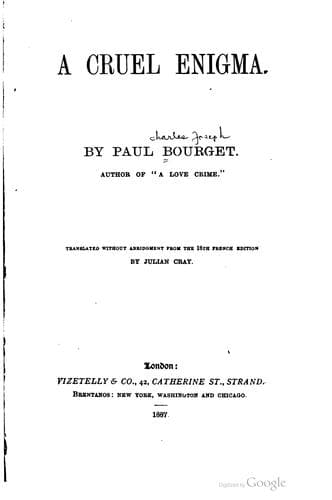
French fiction -- Translations into English; Love -- Fiction; Man-woman relationships -- Fiction
George Liauran had been told the truth. During the unhappy woman's stay
at the seaside there had been enacted in her life one of those secret
dreams of infidelity which frequently occur in the lives of women who
have once deviated from the straight path. But our actions, however
guilty they may be, do not always give the measure of our souls. Madame
de Sauve's nature comprised very lofty portions by the side of very low
ones, and was a singular mixture of corruption and nobility. She might,
indeed, commit abominable faults, but to forgive them in herself, after
the happy custom of most women of the same description, that she could
not do, and now less than ever after what her passion for Hubert had
been to her life for several months.
Ah! her life! her life! It was this that Theresa de Sauve saw in the
flickering flames in the fireplace that autumn evening, with her heart
racked with apprehension. The whole weight of her former errors, her
criminal errors, was now falling upon her heart, and she remembered her
state of dull agony when she had met Hubert. Theresa de Sauve had been
endowed by nature with those dispositions which are most fatal to a
woman in modern society, unless she marries under rare conditions, or
unless maternity saves her from herself by breaking the energies of her
physical, and engrossing the fervour of her moral, vitality. She had a
romantic heart, while her temperament made her a creature of passion,
that is to say, she fostered both dreams of feeling and unconquerable
appetites for sensation.
When persons of this kind meet on the threshold of their lives, with a
man who satisfies the twofold needs of their nature, there are between
them and this man such mysterious festivities of love as poets conceive
but never embrace. Where their destiny wills that they shall be
delivered, as Theresa had been to her husband, to a man who treats them
from the very first like courtesans, who initiates them in deed and
thought into the whole science of pleasure, but who has not sufficient
poetry to satisfy the other half of their souls, such women necessarily
become curiosos, capable of falling into the worst experiences, and then
their sterility even becomes a happiness, for they at least do not
transmit that flame of sentimental and sensual life which they have
commonly inherited from a mother's error.
Public-domain text, read in full here on John Shaqi.
Reviews
Reviews
No reviews yet
Be the first to share your thoughts on this work.
Join the Discussion
Join the discussion
Sign in to leave a comment or review.
Sign InorCreate an account