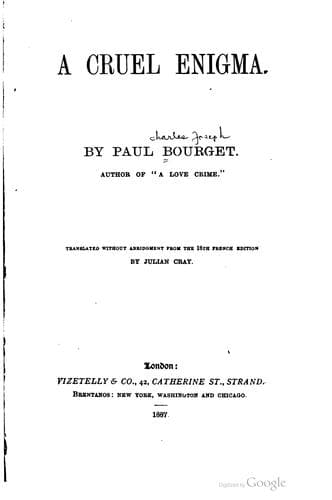
French fiction -- Translations into English; Love -- Fiction; Man-woman relationships -- Fiction
It was, in fact, from her mother, who, cold though she was, had been led
by weariness and abandonment into guilty misconduct, that Theresa
derived her dreamy imagination, while there flowed in her veins the
burning blood of her true father, the handsome Count Branciforte.
Further, this child of license and infatuation had been brought up
without religious principles or bridle of any kind, by Adolphe Lussac, a
most immoral man, who was amused by the little girl's vivacity, and had
early made her a guest at many dinners, where she heard all that she
ought not to have heard, and guessed all that she ought not to have
known. Who can calculate the amount of influence over the falls of a
woman of twenty-five that is attributable to the conversations listened
to or overheard by the young girl in short frocks?
Nevertheless, Theresa, who had married when very young, had had only two
intrigues up to the time of her chance meeting with Hubert, and these
two amours had caused her such disgust that she had sworn that she would
never again fall into the folly of taking a lover. The good resolutions
of a woman who has fallen, and who has suffered for her fault, are like
the firm intentions of a gambler who has lost two thousand pounds, or a
drunkard who has told his secrets during his intoxication. The
deep-lying causes which have produced the first adultery continue to
subsist after the fault has given the guilty one cruelly to taste of
every bitterness.
The woman who takes a lover is not so much attached to this lover as she
is to love, and she continues to be still attached to love when the
chosen lover has deceived her, until disillusion after disillusion
brings her to love pleasure without love, and sometimes pleasure of the
most degrading nature. Theresa de Sauve could never descend so far as
this, because a sentiment of the ideal persisted within her, too feeble
to counterbalance the fever of the senses, but strong enough to illumine
in her own eyes the abyss of her weaknesses. This taciturn woman,
through whom there passed at times the tremors of almost brutal desire,
was no epicurean, no light and cheerful courtesan of the world.
Conceived amid her mother's remorse, Theresa had a tragic soul. She was
capable of depravity, but incapable of that amused forgetfulness which
plucks the fleeting hour, and cannot, without effort, recall the first
lover's name among all the rest. No; this first lover, this Frederick
Suzel, whom George Liauran had justly suspected, could never be thought
of by her without causing her thorough nausea by the recollection of the
sad motives of her surrender to him. He was a man gay even to
buffoonery, and witty even to cynicism, with that sort of wit which is
current between the Opera House, Tortoni, and the Café Anglais.
Public-domain text, read in full here on John Shaqi.
Reviews
Reviews
No reviews yet
Be the first to share your thoughts on this work.
Join the Discussion
Join the discussion
Sign in to leave a comment or review.
Sign InorCreate an account