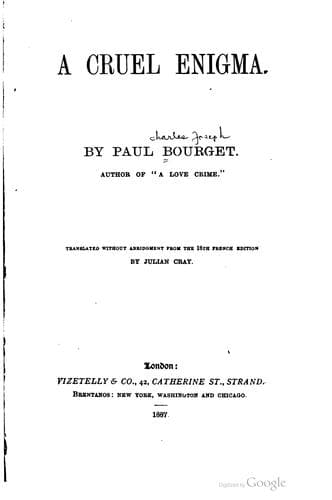
French fiction -- Translations into English; Love -- Fiction; Man-woman relationships -- Fiction
As Emmanuel Deroy had been attached to the embassy at Constantinople
before going to London, his apartments were adorned throughout with
Oriental materials, and this large divan, hung with drapery, and placed
just opposite the door of a little garden, was particularly dear to
Hubert and Theresa. They had chatted so much among these cushions, with
their heads resting unitedly upon them, at those moments of intimacy
which follow upon the intoxications of love, and which, by him at least,
were preferred to them; for, although he loved Theresa to the point of
sacrificing everything for her, he had, nevertheless, at the bottom of
his conscience, remained a Catholic, and a dim remorse mingled its
secret bitterness with the sweetness that was given him by the kisses.
He used to think of his own fault, and especially of the sin which he
caused Theresa to commit; for in the simplicity of his heart he imagined
that he had seduced her.
She sank rather than sat down on the deep divan, and he began to take
off her veil, bonnet, and mantle. She allowed him to do so, smiling at
him the while with infinite tenderness. After her hours of torturing
sleeplessness, there was to her something at once very bitter and very
affecting in the impress of the young man's coaxing. She found him so
affectionate, so delicately intimate, so like himself, that she thought
that she had without doubt been mistaken as to the meaning of the note,
and, to rid herself immediately of uncertainty, she said, in reply to
his question about her health:
"No, I am not ill; but the tone of your note was so strange that it has
made me uneasy."
"My note?" rejoined Hubert, pressing her cold hands, in order to warm
them. "Ah! it was not worth while. Look here, I dare not now acknowledge
to you why I wrote it."
"Acknowledge it all the same," she said, with an already
anguish-stricken insistence, for Hubert's embarrassment had just brought
back to her the anxiety which had caused her so much suffering.
"People are so strange!" replied the young man, shaking his head. "There
are times when, in spite of themselves they doubt what they know best.
But first you must forgive me beforehand."
"Forgive you, my angel!" she said. "Ah! I love you too well! Forgive
you!" she repeated; and these syllables, which she heard her own voice
uttering, echoed in an almost intolerable fashion through her
conscience. How willingly, indeed, would she have had reason to forgive
instead of to be forgiven. "But for what?" she asked, in a lower tone,
which revealed the renewal of her inward emotion.
"For having allowed myself to be disturbed for a moment by an infamous
calumny which persons who hate our love have repeated to me about your
life at Trouville. But what is the matter?"
Public-domain text, read in full here on John Shaqi.
Reviews
Reviews
No reviews yet
Be the first to share your thoughts on this work.
Elsewhere in the archive
Join the Discussion
Join the discussion
Sign in to leave a comment or review.
Sign InorCreate an account