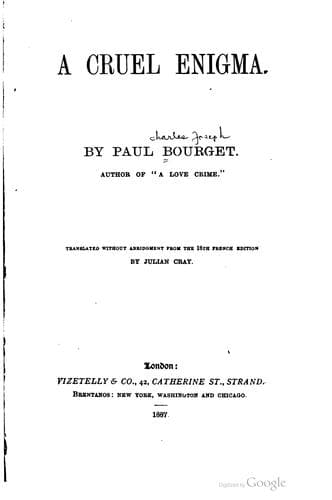
French fiction -- Translations into English; Love -- Fiction; Man-woman relationships -- Fiction
For a year past these three persons had had many silent meals in the
antiquely-wainscoted dining-room--an apartment so spacious as to make
the round table placed in the centre appear small. But all three had
never been sensible of an impression, as they were on this day, that,
even when speaking to one another, there would henceforth be a silence
between them impossible to break, something which could not be put into
words, and which, for a very long time, would create a background of
muteness, even behind their most cordial expansions.
After luncheon, when Hubert, who had scarcely touched the various
dishes, took the handle of the door, in order to leave the little
drawing-room in which he had remained for scarcely five minutes, his
mother felt a timid and almost repentant desire to ask his forgiveness
for the pain that she read on his taciturn countenance.
"Hubert?" she said.
"Mamma?" he replied, turning round.
"You feel quite well to-day?" she asked.
"Quite well," he replied in a blank tone, such a tone as immediately
suppresses all possibility of conversation; and he added: "I shall be
punctual at dinner-time this evening."
The young man was now singularly preoccupied. After a night of torture,
so continuously keen that he could not remember having ever undergone
anything like it, he had become master of himself again. He had passed
through the first crisis of his grief, a crisis after which a man ceases
to die from despair, because he has really reached the deepest depth of
sorrow. Then he had recovered that momentary calm which follows upon
prodigious deperditions of nervous energy, and had been able to think.
It was then that he had been seized with anxiety respecting Madame de
Sauve--an anxiety which was devoid of tenderness, for at this moment,
after the assault of grief which he had just sustained, his soul was
dried up, his inward lethargy was absolute, all capacity for feeling was
gone.
But he had suddenly remembered that he had left Theresa in the little
ground floor apartment in Avenue Friedland, and his imagination dared
not form any conjectures upon what had taken place after his departure.
It was just at the end of luncheon that this thought had assailed him,
and, over and above his main sorrow, it had immediately caused him a
shiver of nervous terror--the only emotion of which he was capable.
He went straight from the Rue Vaneau to the Avenue, and when he found
himself in front of the house he dared not enter, although he had the
key in his hand. He called the doorkeeper, an ugly individual to whom he
could never speak without repugnance, so hateful to him was his brazen,
glabrous face, his servile and, at the same time, insolent eye, and the
tone which he assumed as a generously-paid accomplice.
Public-domain text, read in full here on John Shaqi.
Reviews
Reviews
No reviews yet
Be the first to share your thoughts on this work.
Elsewhere in the archive
Join the Discussion
Join the discussion
Sign in to leave a comment or review.
Sign InorCreate an account