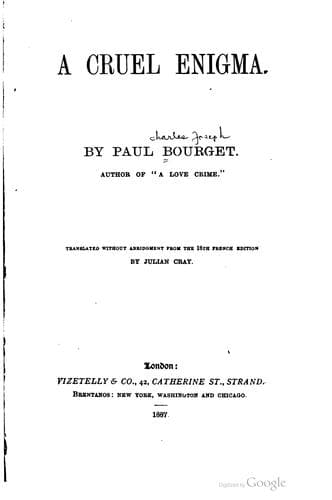
French fiction -- Translations into English; Love -- Fiction; Man-woman relationships -- Fiction
"I thought so much of ourselves while I was sitting. If you knew how
much this likeness, loves you!"
And Hubert felt himself really loved by it. It seemed to him that from
the oval face, the slender lips, and the dream-bathed eyes, there
proceeded a tender effluence which encompassed him, and it was there
that, by the side of the vision of perfidy, there began to rise afresh
the vision of Theresa's love. He knew as clearly from the memories of
this woman that she had loved, and still loved him, as he knew from her
own confession that she had betrayed him. He saw her again as he had
left her on the sofa in their retreat, with her face convulsed, and,
above all, her tears--ah, what tears! For the first time since the fatal
hour he perceived the nobility with which she had acknowledged her
fault, when it was so easy for her to speak falsely, and he suddenly
uttered a cry which hitherto had not come to him through his days of
parched and passionate pain:
"But why? why?"
Yes, why? why? This anguish of a completely moral order henceforward
accompanied the anguish of physical sight. Hubert began to think, not
only about his trouble, but about the cause of his trouble. To burn
these letters, to tear this likeness, to break and throw away the chain
and ring, to destroy this last remnant of his love, would have been as
impossible to him as to rend with steel his mistress's quivering body.
These objects were living persons with looks, caresses, pantings,
voices. He closed the drawer, unable any longer to endure the presence
of these things which to him seemed made of the very substance of his
heart.
He threw himself upon the couch and lost himself in the gulf of his
reflection. Yes, Theresa had loved him, and Theresa loved him still.
There are tears, embraces, and a warmth of soul which do not lie. She
loved him and she had betrayed him! With his own name in her heart she
had given herself to another, less than six weeks after leaving him! But
why? why? Driven by what force? Led away by what dizziness? Overwhelmed
by what intoxication? What was the nature--not of women of that sort
now, for he had no longer any such fierceness of thought--but of woman,
that so monstrous an action should be barely possible to her? Of what
flesh was she formed, this deceiving creature, that with all the
appearances and all the realities of love, it was not possible to place
more reliance upon her than upon water.
Public-domain text, read in full here on John Shaqi.
Reviews
Reviews
No reviews yet
Be the first to share your thoughts on this work.
Elsewhere in the archive
Join the Discussion
Join the discussion
Sign in to leave a comment or review.
Sign InorCreate an account