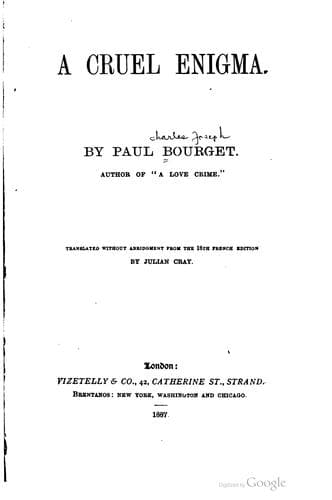
French fiction -- Translations into English; Love -- Fiction; Man-woman relationships -- Fiction
His mother had accustomed him to have nothing to say to scepticism. This
is probably the surest method of causing the first deception to
transform the too implicit believer into an absolute negator. It is
never well to expect much from men or from nature, for the former are
wild animals scantily masked with decorum; while, as for the latter, her
apparent harmony is the result of an injustice which knows no remission.
To preserve the ideal within us until death at last releases us from the
dangerous slavery to others and to ourselves, we must early habituate
ourselves to regard the universe of moral beauty as the opium-smoker
regards the dreams of his intoxication. Their charm consists in the fact
that they are dreams, and consequently correspond to nothing that is
real.
Hubert, quite on the contrary, was so accustomed to move his intellect
in one piece that he was unable to doubt or to believe by halves. If
Theresa had lied to him why should not everyone do the same? This idea
did not frame itself in an abstract form, nor did he arrive at it by the
aid of reasoning: it was the substitution of one mode of feeling for
another. During this cruel period he found himself suspecting Theresa in
their common past.
He asked himself whether her betrayal at Trouville had been the first,
whether she had not had another lover than himself at the time of their
most infatuated passion. This woman's perfidy was corrupting his very
recollections. It was doing worse. Under this misanthropical influence
he committed the greatest of moral crimes: he doubted his mother's
tenderness. Yes, in Madame Liauran's passionate affection the unhappy
fellow could see nothing but jealous egotism.
"If she really loved me," he said to himself, "she would not have told
me what she did."
Thus, he found himself in that state of feeling to which popular
language has given the expressive name of disenchantment. He had seen
the last of the beauty of the human soul, and he was beginning to prove
its misery, and always he fell back upon this question as upon the point
of a sword:
"But why? why?"
And he sifted Theresa's character without meeting with any reply. He
might as well have asked why Theresa had senses as well as a heart, and
why at certain times there was set up, as with men, a divorce between
the longings of her heart and the tyranny of her senses. Those
debauchees in whom libertinism has not killed sentimentality know the
secret of these divorces; but Hubert was not a debauchee. He must remain
pure even in his despair, and it never occurred to him to seek
forgetfulness of his trouble in the intoxication of loveless kisses. He
was still ignorant of venal and consoling alcoves--where men lose indeed
their regrets, but at the cost of losing their dreams.
Public-domain text, read in full here on John Shaqi.
Reviews
Reviews
No reviews yet
Be the first to share your thoughts on this work.
Elsewhere in the archive
Join the Discussion
Join the discussion
Sign in to leave a comment or review.
Sign InorCreate an account