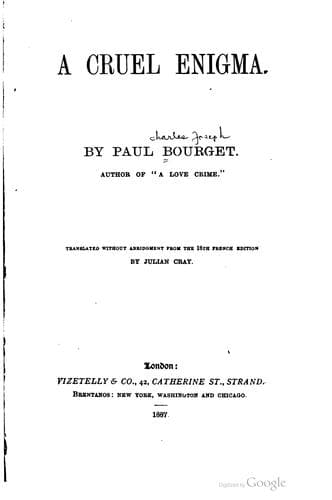
French fiction -- Translations into English; Love -- Fiction; Man-woman relationships -- Fiction
He suddenly recollected the tears of the night at Folkestone, and the
tears, also, at their last interview; and, as though he had at last
understood their meaning, he could find within him but a single
utterance, which he whispered there in the restaurant filled with the
smoke of cigars, then beneath the leafless trees of the Tuileries, then
in the solitude of his own room in the Rue Vaneau--a single utterance,
but one filled with the perception of the degrading fatalities of his
life:
"What misery! My God, what misery!"
CHAPTER XI
What was Theresa doing while he was suffering thus, and why did she
afford him no sign of her existence? Although the young man had
forbidden himself to think about her, he thought of her nevertheless,
and this question came to add anxiety to his other anguish.
Contradictory hypotheses passed in turns through his mind. Had Theresa
died of remorse? Had she ceased to love him? Had she kept La
Croix-Firmin for her lover? Was she pursuing a fresh intrigue.
Everything seemed possible to Hubert, the worst as well as the best, on
the part of this woman whom he had learned to be so strangely compounded
of refinement and libertinism, of treachery and nobility. He then
ascertained by the heart-burning caused him by some of his hypotheses,
by what living fibres he still clung to this being from whom he wished
himself released.
He was on the point of taking some steps in order at least to learn what
the inclinations of her own soul were at that moment; then he despised
himself for the weakness, and, to strengthen himself, he repeated some
verses which were in correspondence with his condition of mind. He found
them, by a strange irony of destiny which he did not suspect, in the
single collection of poetry by Alfred Fanières. This volume, which had
been reprinted after the poet's novels had made him celebrated, bore a
title which was in itself a revelation of youthfulness: "Early Pride."
Hubert had dined, in company with the writer, at Madame de Sauve's house
without suspecting what the poor woman felt at being obliged by her
husband to receive at her table the lover whom she idolised and the man
with whom she had broken. Fanières had talked cleverly that evening,
and it was after that dinner that the young man, with very natural
curiosity, had obtained the book of verse at a bookseller's. The poem
which pleased him just now was a sonnet, somewhat pretentiously called
"Tender Cruelty":--
Public-domain text, read in full here on John Shaqi.
Reviews
Reviews
No reviews yet
Be the first to share your thoughts on this work.
Elsewhere in the archive
Join the Discussion
Join the discussion
Sign in to leave a comment or review.
Sign InorCreate an account