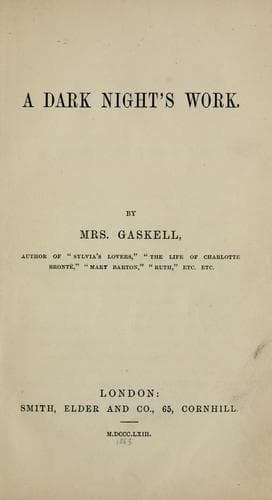
England -- Social life and customs -- 19th century -- Fiction
This last, it seemed, was to be Ellinor's lot. Her youth had gone in a
single night, fifteen years ago, and now she appeared to have become an
elderly woman; very still and hopeless in look and movement, but as sweet
and gentle in speech and smile as ever she had been in her happiest days.
All young people, when they came to know her, loved her dearly, though at
first they might call her dull, and heavy to get on with; and as for
children and old people, her ready watchful sympathy in their joys as
well as their sorrows was an unfailing passage to their hearts. After
the first great shock of Mr. Corbet's marriage was over, she seemed to
pass into a greater peace than she had known for years; the last faint
hope of happiness was gone; it would, perhaps, be more accurate to say,
of the bright happiness she had planned for herself in her early youth.
Unconsciously, she was being weaned from self-seeking in any shape, and
her daily life became, if possible, more innocent and pure and holy. One
of the canons used to laugh at her for her constant attendance at all the
services, and for her devotion to good works, and call her always the
reverend sister. Miss Monro was a little annoyed at this faint clerical
joke; Ellinor smiled quietly. Miss Monro disapproved of Ellinor's grave
ways and sober severe style of dress.
"You may be as good as you like, my dear, and yet go dressed in some
pretty colour, instead of those perpetual blacks and greys, and then
there would be no need for me to be perpetually telling people you are
only four-and-thirty (and they don't believe me, though I tell them so
till I am black in the face). Or, if you would but wear a decent-shaped
bonnet, instead of always wearing those of the poky shape in fashion when
you were seventeen."
The old canon died, and some one was to be appointed in his stead. These
clerical preferments and appointments were the all-important interests to
the inhabitants of the Close, and the discussion of probabilities came up
invariably if any two met together, in street or house, or even in the
very cathedral itself. At length it was settled, and announced by the
higher powers. An energetic, hard-working clergyman from a distant part
of the diocese, Livingstone by name, was to have the vacant canonry.
Public-domain text, read in full here on John Shaqi.
Reviews
Reviews
No reviews yet
Be the first to share your thoughts on this work.
Elsewhere in the archive
Join the Discussion
Join the discussion
Sign in to leave a comment or review.
Sign InorCreate an account