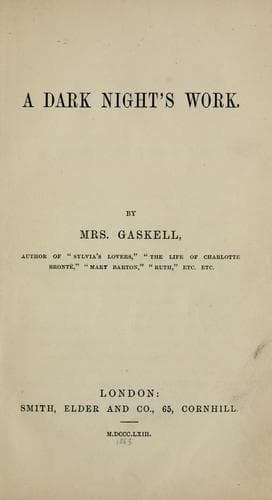
England -- Social life and customs -- 19th century -- Fiction
"Drive to Mr. Johnson's in the High street--quick, quick. I will give
you half-a-crown if you will go quick."
For, indeed, her endurance, her patience, was strained almost to
snapping; yet at Hellingford station, where doubtless they could have
told her the truth, she dared not ask the question. It was past eight
o'clock at night. In many houses in the little country town there were
unusual lights and sounds. The inhabitants were showing their
hospitality to such of the strangers brought by the assizes, as were
lingering there now that the business which had drawn them was over. The
Judges had left the town that afternoon, to wind up the circuit by the
short list of a neighbouring county town.
Mr. Johnson was entertaining a dinner-party of attorneys when he was
summoned from dessert by the announcement of a "lady who wanted to speak
to him immediate and particular."
He went into his study in not the best of tempers. There he found his
client, Miss Wilkins, white and ghastly, standing by the fireplace, with
her eyes fixed on the door.
"It is you, Miss Wilkins! I am very glad--"
"Dixon!" said she. It was all she could utter.
Mr. Johnson shook his head.
"Ah; that's a sad piece of business, and I'm afraid it has shortened your
visit at Rome."
"Is he--?"
"Ay, I'm afraid there's no doubt of his guilt. At any rate, the jury
found him guilty, and--"
"And!" she repeated, quickly, sitting down, the better to hear the words
that she knew were coming--
"He is condemned to death."
"When?"
"The Saturday but one after the Judges left the town, I suppose--it's the
usual time."
"Who tried him?"
"Judge Corbet; and, for a new judge, I must say I never knew one who got
through his business so well. It was really as much as I could stand to
hear him condemning the prisoner to death. Dixon was undoubtedly guilty,
and he was as stubborn as could be--a sullen old fellow who would let no
one help him through. I'm sure I did my best for him at Miss Monro's
desire and for your sake. But he would furnish me with no particulars,
help us to no evidence. I had the hardest work to keep him from
confessing all before witnesses, who would have been bound to repeat it
as evidence against him. Indeed, I never thought he would have pleaded
'Not Guilty.' I think it was only with a desire to justify himself in
the eyes of some old Hamley acquaintances. Good God, Miss Wilkins!
What's the matter? You're not fainting!" He rang the bell till the rope
remained in his hands. "Here, Esther! Jerry! Whoever you are, come
quick! Miss Wilkins has fainted! Water! Wine! Tell Mrs. Johnson to
come here directly!"
Mrs. Johnson, a kind, motherly woman, who had been excluded from the
"gentleman's dinner party," and had devoted her time to superintending
the dinner her husband had ordered, came in answer to his call for
assistance, and found Ellinor lying back in her chair white and
senseless.
Public-domain text, read in full here on John Shaqi.
Reviews
Reviews
No reviews yet
Be the first to share your thoughts on this work.
Elsewhere in the archive
Join the Discussion
Join the discussion
Sign in to leave a comment or review.
Sign InorCreate an account