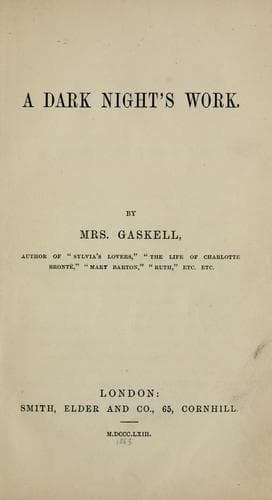
England -- Social life and customs -- 19th century -- Fiction
But no more was spoken on the subject. The next day, Canon Livingstone
made his formal call. Ellinor would fain have kept Miss Monro in the
room, but that worthy lady knew better than to stop.
They went on, forcing talk on indifferent subjects. At last he could
speak no longer on everything but that which he had most at heart. "Miss
Wilkins!" (he had got up, and was standing by the mantelpiece, apparently
examining the ornaments upon it)--"Miss Wilkins! is there any chance of
your giving me a favourable answer now--you know what I mean--what we
spoke about at the Great Western Hotel, that day?"
Ellinor hung her head.
"You know that I was once engaged before?"
"Yes! I know; to Mr. Corbet--he that is now the judge; you cannot
suppose that would make any difference, if that is all. I have loved
you, and you only, ever since we met, eighteen years ago. Miss
Wilkins--Ellinor--put me out of suspense."
"I will!" said she, putting out her thin white hand for him to take and
kiss, almost with tears of gratitude, but she seemed frightened at his
impetuosity, and tried to check him. "Wait--you have not heard all--my
poor, poor father, in a fit of anger, irritated beyond his bearing,
struck the blow that killed Mr. Dunster--Dixon and I knew of it, just
after the blow was struck--we helped to hide it--we kept the secret--my
poor father died of sorrow and remorse--you now know all--can you still
love me? It seems to me as if I had been an accomplice in such a
terrible thing!"
"Poor, poor Ellinor!" said he, now taking her in his arms as a shelter.
"How I wish I had known of all this years and years ago: I could have
stood between you and so much!"
Those who pass through the village of Bromham, and pause to look over the
laurel-hedge that separates the rectory garden from the road, may often
see, on summer days, an old, old man, sitting in a wicker-chair, out upon
the lawn. He leans upon his stick, and seldom raises his bent head; but
for all that his eyes are on a level with the two little fairy children
who come to him in all their small joys and sorrows, and who learnt to
lisp his name almost as soon as they did that of their father and mother.
Nor is Miss Monro often absent; and although she prefers to retain the
old house in the Close for winter quarters, she generally makes her way
across to Canon Livingstone's residence every evening.
SO ENDS "A DARK NIGHT'S WORK."
Public-domain text, read in full here on John Shaqi.
Reviews
Reviews
No reviews yet
Be the first to share your thoughts on this work.
Elsewhere in the archive
Join the Discussion
Join the discussion
Sign in to leave a comment or review.
Sign InorCreate an account