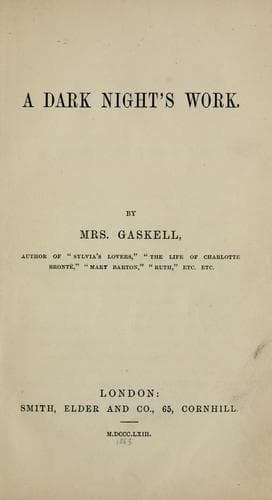
England -- Social life and customs -- 19th century -- Fiction
People in general were rather astonished at the eagerness Miss Wilkins
showed to sell all the Ford Bank furniture. Even Miss Monro was a little
scandalized at this want of sentiment, although she said nothing about
it; indeed justified the step, by telling every one how wisely Ellinor
was acting, as the large, handsome, tables and chairs would be very much
out of place and keeping with the small, oddly-shaped rooms of their
future home in East Chester Close. None knew how strong was the instinct
of self-preservation, it may almost be called, which impelled Ellinor to
shake off, at any cost of present pain, the incubus of a terrible
remembrance. She wanted to go into an unhaunted dwelling in a free,
unknown country--she felt as if it was her only chance of sanity.
Sometimes she thought her senses would not hold together till the time
when all these arrangements were ended. But she did not speak to any one
about her feelings, poor child; to whom could she speak on the subject
but to Dixon? Nor did she define them to herself. All she knew was,
that she was as nearly going mad as possible; and if she did, she feared
that she might betray her father's guilt. All this time she never cried,
or varied from her dull, passive demeanour. And they were blessed tears
of relief that she shed when Miss Monro, herself weeping bitterly, told
her to put her head out of the post-chaise window, for at the next
turning of the road they would catch the last glimpse of Hamley church
spire.
Late one October evening, Ellinor had her first sight of East Chester
Close, where she was to pass the remainder of her life. Miss Monro had
been backwards and forwards between Hamley and East Chester more than
once, while Ellinor remained at the parsonage; so she had not only the
pride of proprietorship in the whole of the beautiful city, but something
of the desire of hospitably welcoming Ellinor to their joint future home.
"Look! the fly must take us a long round, because of our luggage; but
behind these high old walls are the canons' gardens. That high-pitched
roof, with the clumps of stonecrop on the walls near it, is Canon
Wilson's, whose four little girls I am to teach. Hark! the great
cathedral clock. How proud I used to be of its great boom when I was a
child! I thought all the other church clocks in the town sounded so
shrill and poor after that, which I considered mine especially. There
are rooks flying home to the elms in the Close. I wonder if they are the
same that used to be there when I was a girl. They say the rook is a
very long-lived bird, and I feel as if I could swear to the way they are
cawing. Ay, you may smile, Ellinor, but I understand now those lines of
Gray's you used to say so prettily--
"I feel the gales that from ye blow.
A momentary bliss bestow,
And breathe a second spring."
Public-domain text, read in full here on John Shaqi.
Reviews
Reviews
No reviews yet
Be the first to share your thoughts on this work.
Elsewhere in the archive
Join the Discussion
Join the discussion
Sign in to leave a comment or review.
Sign InorCreate an account