"You speak as if happiness was 'the because' of life. Do? Do your duty,
and you will be happy, whatever wind blows. And as to my having pity on
you, I would love you little if I gave way now to your impatience and
your wounded pride. Who loves you if I don't? I am aye thinking of the
days when we will have a braw house of our ain. Can you not wait?"
"It is lang waiting; and many a hope goes wi' the weeks and the months.
Davie, I canna go back."
"You must go back. I will write a letter to Dr. Balmuto and ask him to put
you with some decent family in Kinkell: and keep his own eye on you. What
can you want more than that? And let me tell you, Maggie, I think it very
unsisterly of you, bothering and hampering me with women's quarrels, when
I am making myself a name among them that will be looked to for the
carrying on o' the kirk in the future. But I'll say no more, and I'll
forgive this romantic folly o' yours, and to-morrow I'll put you in the
Stirling train, and you'll go, as I tell you, to Dr. Balmuto."
Maggie made no further objections. David wrote the promised letter, and he
spent a part of the next day in showing her the "wonderfuls" of the
cathedral and the college. He was even gentle with her at the last, and
not a little proud of the evident sensation her fresh, brilliant beauty
caused; and he asked her about her money matters, and when he put her in
the train, kissed her fondly; and bade her "be brave, and patient, and
cheerful."
And still Maggie said nothing. Her eyes were full of tears, and she looked
once or twice at her brother in a way that made his heart dirl and ache;
but she seemed to have resigned herself to his direction. Only, at the
first station beyond Glasgow, she got out of the train, and she allowed it
to go on to Stirling without her.
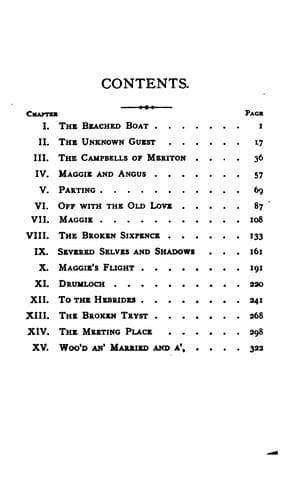
CHAPTER XI.
DRUMLOCH.
"Brown shell first for the butterfly
And a bright wing by and by.
Butterfly good-bye to your shell,
And, bright wings, speed you well"
In leaving the train Maggie had not yielded to a passing impulse. It was a
deliberate act. David's indifference to her happiness, his subordination
of all her likes and dislikes, her time, and work, and hopes, to his own
ambition shocked and pained her. She had spent the night in thought and
had reached a decided conclusion. As they walked about the cathedral and
college, and up and down the High Street, while she looked with shuddering
horror on the squalid, hopeless poverty of the inhabitants of those
localities, she asked her brother where the rich people lived.
"At the West End," answered David. "On Sauchiehall Road, and the crescents
further on, away maistly up to Kelvin Grove." And later on, as they were
passing down Buchanan Street, he pointed out the stages which ran
constantly to these aristocratic quarters of the city, and asked, "if she
wished to see them?"
"Ay, I wad like too, but there's little time noo, it will do again."
Public-domain text, read in full here on John Shaqi.
Reviews
Reviews
No reviews yet
Be the first to share your thoughts on this work.
Elsewhere in the archive
Join the Discussion
Join the discussion
Sign in to leave a comment or review.
Sign InorCreate an account