Allan had distinctly spoken of his home as being in Bute; and of his
cousin, as living in the same house with him from her childhood. Mary, in
her own castle in Ayrshire, was certainly far enough away from all Allan's
statements to destroy every suspicion of her identify. And the name of
"Campbell" told her nothing at all. As Mary said, "The Campbells were a
big clan." They abounded throughout the west of Scotland. Around Drumloch,
every third man was a Campbell. In Glasgow the name was prominent on the
sign boards of every street. In a Fife fishing village there are rarely
more than four or five surnames. A surname had not much importance in
Maggie's eyes. She had certainly noticed that "Campbell" frequently met
"Promoter;" but certain names seem to have affinities for certain lives;
at least certain letters do; and Maggie, quoting a superstition of her
class, settled the matter to her own satisfaction, by reflecting "what
comes to me wi' a 'C,' aye comes wi' good to me."
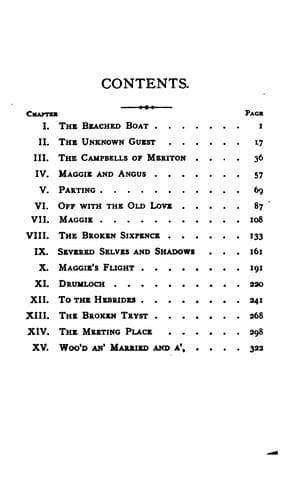
CHAPTER XII
TO THE HEBRIDES.
"And yet when all is thought and said.
The heart still overrules the head."
"From the lone shieling of the misty islands.
Mountains divide us, and the waste of seas:
But we in dreams behold the Hebrides."
One morning toward the end of July, Mary was reading the "Glasgow Herald."
"Maggie," she said, "one of the Promoters has evidently left Fife, for I
see the name among the list of students--David Promoter--he has done
wondrously. The man is a miracle, he has taken every prize in his classes,
I think."
"I'm right glad to hear tell o' it. I must aye wish weel--"
"_Well_, Maggie, not weel."
"Well, to the name."
It was true. David had overstepped even his own ambition. He had finished
the term with an ovation from his fellows, and he had been urged to go
with Prof. Laird's son to the outer Hebrides. And now that the strain of
his study was over, and the goal, so far, nobly won, he could afford to
remember his sister. Indeed David deserves more justice than these words
imply. He had often thought of her since that March afternoon when he had
put her into the train for Stirling. But he really believed that his first
duty was to his studies, and he fully expected that his letter to Dr.
Balmuto would be a sufficient movement to insure her welfare. Practically,
he had thrown his own duty upon the minister's conscience, but he felt
sure that the good man had accepted the obligation, for if not, he would
certainly have written to him on the subject.
Public-domain text, read in full here on John Shaqi.
Reviews
Reviews
No reviews yet
Be the first to share your thoughts on this work.
Elsewhere in the archive
Join the Discussion
Join the discussion
Sign in to leave a comment or review.
Sign InorCreate an account