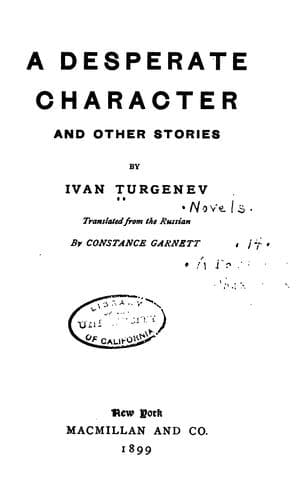
A Desperate Character and Other StoriesTurgenev, Ivan Sergeevich
General
A Desperate Character and Other Stories
Turgenev, Ivan Sergeevich
Russia -- Social life and customs -- Fiction; Turgenev, Ivan Sergeevich, 1818-1883 -- Translations into English
Vassilissa turned away.
‘You laughed, you laughed, my love!’ cried Pyetushkov, and he capered
about like a child.
VI
The next day Pyetushkov went to the baker’s shop as usual. Everything
went on as before. But there was a settled ache at his heart. He did not
laugh now as often, and sometimes he fell to musing. Sunday came.
Praskovia Ivanovna had an attack of lumbago; she did not get down from
the shelf bed, except with much difficulty to go to mass. After mass
Pyetushkov called Vassilissa into the back room. She had been
complaining all the morning of feeling dull. To judge by the expression
of Ivan Afanasiitch’s countenance, he was revolving in his brain some
extraordinary idea, unforeseen even by him.
‘You sit down here, Vassilissa,’ he said to her, ‘and I’ll sit here. I
want to have a little talk with you.’
Vassilissa sat down.
‘Tell me, Vassilissa, can you write?’
‘Write?’
‘Yes, write?’
‘No, I can’t.’
‘What about reading?’
‘I can’t read either.’
‘Then who read you my letter?’
‘The deacon.’
Pyetushkov paused.
‘But would you like to learn to read and write?’
‘Why, what use would reading and writing be to us, Ivan Afanasiitch?’
‘What use? You could read books.’
‘But what good is there in books?’
‘All sorts of good ... I tell you what, if you like, I’ll bring
you a book.’
‘But I can’t read, you see, Ivan Afanasiitch.’
‘I’ll read to you.’
‘But, I say, won’t it be dull?’
‘Nonsense! dull! On the contrary, it’s the best thing to get rid
of dulness.’
‘Maybe you’ll read stories, then.’
‘You shall see to-morrow.’
In the evening Pyetushkov returned home, and began rummaging in his
boxes. He found several odd numbers of the Library of Good Reading, five
grey Moscow novels, Nazarov’s arithmetic, a child’s geography with a
globe on the title-page, the second part of Keydanov’s history, two
dream-books, an almanack for the year 1819, two numbers of Galatea,
Kozlov’s _Natalia Dolgorukaia_, and the first part of _Roslavlev_. He
pondered a long while which to choose, and finally made up his mind to
take Kozlov’s poem, and _Roslavlev_.
Next day Pyetushkov dressed in haste, put both the books under the lapel
of his coat, went to the baker’s shop, and began reading aloud
Zagoskin’s novel. Vassilissa sat without moving; at first she smiled,
then seemed to become absorbed in thought ... then she bent a little
forward; her eyes closed, her mouth slightly opened, her hands fell on
her knees; she was dozing. Pyetushkov read quickly, inarticulately, in a
thick voice; he raised his eyes ...
‘Vassilissa, are you asleep?’
She started, rubbed her face, and stretched. Pyetushkov felt angry with
her and with himself....
‘It’s dull,’ said Vassilissa lazily.
‘I tell you what, would you like me to read you poetry?’
‘What say?’
‘Poetry ... good poetry.’
‘No, that’s enough, really.’
Public-domain text, read in full here on John Shaqi.
Reviews
Reviews
No reviews yet
Be the first to share your thoughts on this work.
Elsewhere in the archive
Join the Discussion
Join the discussion
Sign in to leave a comment or review.
Sign InorCreate an account