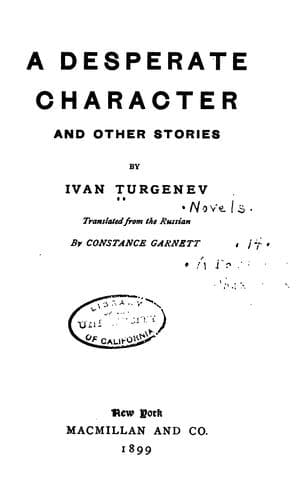
A Desperate Character and Other StoriesTurgenev, Ivan Sergeevich
General
A Desperate Character and Other Stories
Turgenev, Ivan Sergeevich
Russia -- Social life and customs -- Fiction; Turgenev, Ivan Sergeevich, 1818-1883 -- Translations into English
‘There are, to be sure there are,’ answered Onisim, as he thrust one
foot forward. ‘Does your honour know the non-commissioned officer,
Krupovaty? ... His brother was ruined by witchcraft. He was bewitched
to love an old woman, a cook, if your honour only can explain that! They
gave him nothing but a morsel of rye bread, with a muttered spell, of
course. And Krupovaty’s brother simply lost his heart to the cook, he
fairly ran after the cook, he positively adored her--couldn’t keep his
eyes off her. She might tell him to do anything, he’d obey her on the
spot. She’d even make a joke of him before other people, before
strangers. Well, she drove him into a decline, at last. And so it was
Krupovaty’s brother died. And you know, she was a cook, and an old woman
too, very old. (Onisim took a pinch of snuff.) Confound the lot of them,
these girls and women-folk!’
‘She doesn’t care for me a bit, that’s clear, at last; that’s beyond all
doubt, at last,’ Pyetushkov muttered in an undertone, gesticulating with
his head and hands as though he were explaining to a perfectly
extraneous person some perfectly extraneous fact.
‘Yes,’ Onisim resumed, ‘there are women like that.’
‘There are,’ listlessly repeated Pyetushkov, in a tone half questioning,
half perplexed.
Onisim looked intently at his master.
‘Ivan Afanasiitch,’ he began, ‘wouldn’t you have a snack of something?’
‘Wouldn’t I have a snack of something?’ repeated Pyetushkov.
‘Or may be you’d like to have a pipe?’
‘To have a pipe?’ repeated Pyetushkov.
‘So this is what it’s coming to,’ muttered Onisim. ‘It’s gone deep,
it seems.’
VIII
The creak of boots resounded in the passage, and then there was heard
the usual suppressed cough which announces the presence of a person
of subordinate position. Onisim went out and promptly came back,
accompanied by a diminutive soldier with a little, old woman’s face,
in a patched cloak yellow with age, and wearing neither breeches nor
cravat. Pyetushkov was startled; while the soldier drew himself up,
wished him good day, and handed him a large envelope bearing the
government seal. In this envelope was a note from the major in
command of the garrison: he called upon Pyetushkov to come to him
without fail or delay.
Pyetushkov turned the note over in his hands, and could not refrain from
asking the messenger, did he know why the major desired his presence,
though he was very well aware of the utter futility of his question.
‘We cannot tell!’ the soldier cried, with great effort, yet hardly
audibly, as though he were half asleep.
‘Isn’t he summoning the other officers?’ Pyetushkov pursued.
‘We cannot tell,’ the soldier cried a second time, in just the
same voice.
‘All right, you can go,’ pronounced Pyetushkov.
The soldier wheeled round to the left, scraping his foot as he did so,
and slapping himself below the spine (this was considered smart in the
twenties), withdrew.
Public-domain text, read in full here on John Shaqi.
Reviews
Reviews
No reviews yet
Be the first to share your thoughts on this work.
Elsewhere in the archive
Join the Discussion
Join the discussion
Sign in to leave a comment or review.
Sign InorCreate an account